


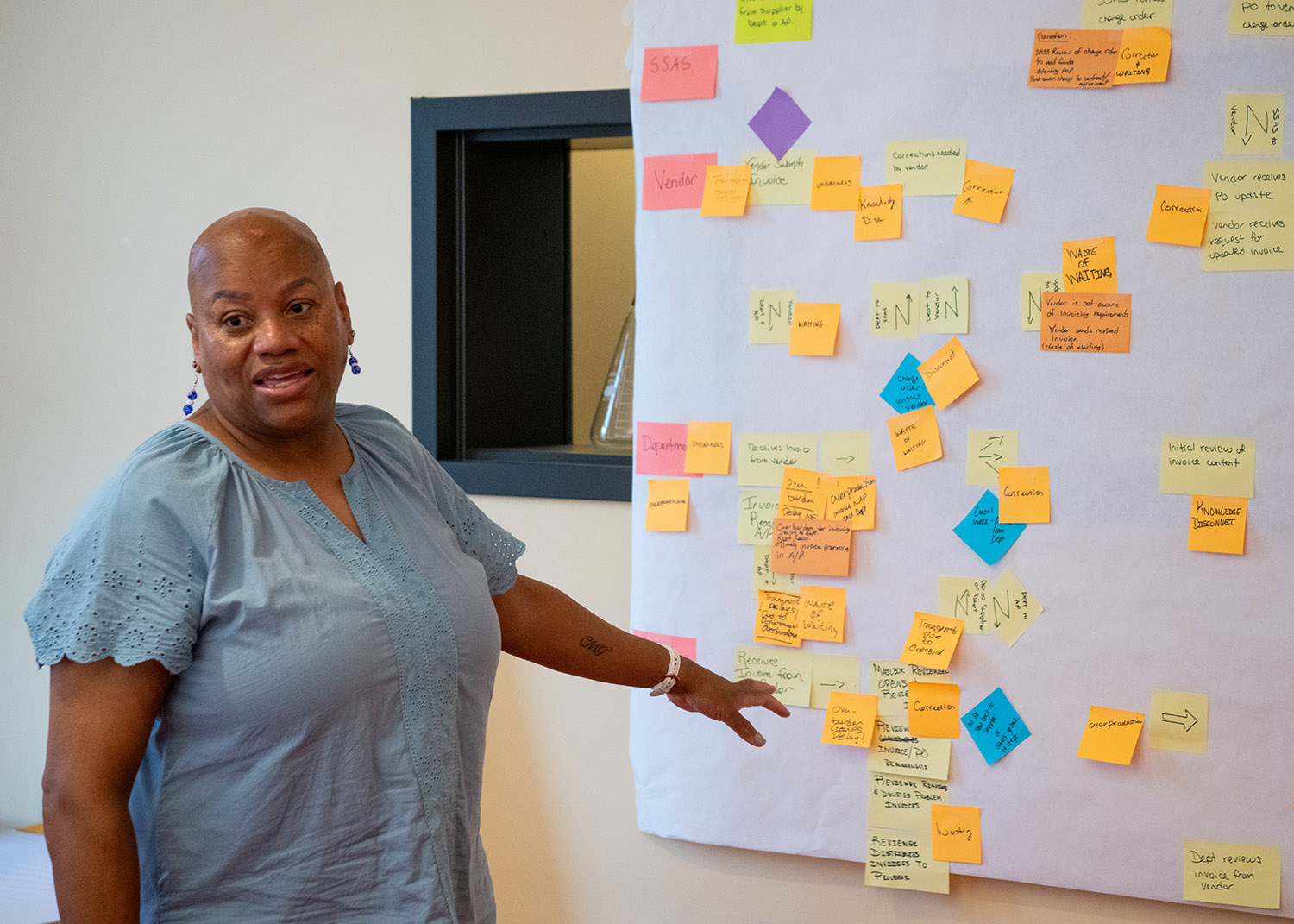
UMB ELEVATE provides teams with practical, structured approaches for turning improvement opportunities into meaningful and sustainable results. Not every improvement requires the same approach. Depending on the opportunity, teams may use Rapid Improvement Events (RIEs), structured problem solving, process mapping, root cause analysis, PDCA (Plan-Do-Check-Act), standard work, or other continuous improvement methods.
Rapid Improvement Events (RIEs) are one of UMB ELEVATE's primary approaches for addressing opportunities that benefit from focused, collaborative improvement. Led by trained facilitators, RIEs bring together the people closest to the work, along with key stakeholders, to understand the current process, identify barriers and opportunities, and develop practical solutions.
Formal RIEs focus on improvement opportunities identified across UMB and selected for this more intensive, team-based approach. Depending on the scope and complexity of the opportunity, an RIE may range from focused working sessions to a multi-day event. RIEs follow UMB ELEVATE's five-step improvement approach:
- Learning – Understand the current process and the needs of those it serves.
- Discovery – Identify barriers, unnecessary effort, process gaps, and opportunities to add value.
- Improvement – Generate, discuss, and evaluate potential improvements.
- Process Design – Develop the improved future-state process.
- Planned Implementation – Establish actions, responsibilities, measures, and approaches for implementing and sustaining improvements.
View the Report Out On AP Payment PO Invoice Review
View the Report Out On PCard Purchase Contract Review
Beyond RIEs
Continuous improvement does not happen only through formal events. UMB ELEVATE supports improvements of different sizes and levels of complexity, helping teams select an approach that fits the problem they are trying to solve.
For example, teams may use:
- Structured Problem Solving to clearly define a problem, examine evidence, identify root causes, test countermeasures, and evaluate results.
- PDCA (Plan-Do-Check-Act) to test ideas on a manageable scale, learn from the results, and refine improvements through repeated cycles.
- Process Mapping to make work visible, understand how information or services flow, and identify opportunities to simplify the process.
- Root Cause Analysis to look beyond symptoms and better understand the underlying factors contributing to a problem.
- Standard Work to document and sustain an improved way of performing recurring work while creating a baseline for future learning and improvement.
- Performance Measures to establish whether changes are producing the intended results and identify when further adjustment may be needed.
Whether the work involves a formal RIE or a smaller improvement effort, the people closest to the work remain central to understanding the problem and developing the solution. UMB ELEVATE provides the coaching, facilitation, methods, and tools to help teams move from identifying an opportunity to implementing, measuring, and sustaining improvement.
For formal RIEs, teams can also share their work with University leadership through a report-out, highlighting what they learned, the future-state process, recommended improvements, implementation actions, and measures of success.