


Procurement
Purpose
The purpose of this policy is to establish standards and requirements for the procurement of goods and services through the Maryland Global Initiatives Corporation (MGIC), on behalf of Requesting Units and for the corporate business needs of MGIC.
Background
MGIC was established by the University System of Maryland (USM) Board of Regents as an affiliated, non-State business entity, to facilitate academic affiliations and experiences and research activities outside the United States (U.S.). As stated in the Board of Regents’ authorization, “the State of Maryland’s administrative, human resources, procurement and financial systems are not intended to support and are not adaptable to operations in foreign countries.” MGIC enables the University of Maryland, Baltimore (UMB) and other USM constituent institutions to which UMB provides MGIC services (hereafter referred to solely for the purpose of MGIC policies as “UMB Affiliate Entities”) to mitigate institutional risk, comply with applicable laws and regulations, and reflect sound business and partnership principles in pursuing their global missions.
MGIC may be used to purchase goods and services from sources outside the U.S., for the educational, research, or service activities of Requesting Units or for the administration of MGIC. (See policy on Use and Administration of MGIC). As defined in this policy:
- Goods are physical equipment, supplies, products, and other tangible assets (capital or non-capital, see definitions of asset types in MGIC Property Management Policy).
- Services are work or expertise provided by a supplier. Unlike goods, which are physical items, services are not tangible; they involve people’s skills and effort and are measured by performance.
- Commercial Goods and Services are sold on the open commercial market, in which the vendor has a Standard Supplier Agreement or a “Click through Agreement.” Examples include but are not limited to lodging, airfare, conference fees, memberships, service subscriptions, transportation rental, and various other business services.
- Non-Commercial Goods and Services are not generally offered to the public, nor are they sold in the open market. These Goods and Services are specialized or customized and are provided to specific clients under negotiable terms and conditions. For example, professional expertise for a specific need, such as Research or Academic consultants.
The International Operations (IO) division of UMB’s Administration & Finance department administers and leads the MGIC procurement process. IO is responsible for maintaining current operating procedures, business forms, job tools, and information resources that facilitate responsiveness to audits and inquiries, support Requesting Unit personnel to comply with policy, safeguard confidential data, and establish just and equitable relationships with foreign collaborators and vendors.
Policy Statement
Overarching Procurement Standards
- Only authorized persons in IO may prepare and alter MGIC contract instruments.
- Only the MGIC President, the MGIC Vice President – Policy & Administration, or their assigned delegates in writing, have the authority to execute (sign) MGIC contract instruments. Only legitimate and appropriate contracts that follow MGIC procurement policy shall be executed.
- MGIC procurement thresholds are established to facilitate responsible and expedient business decisions, define extent of competition, ensure segregation of duties, and add additional layers of approval scrutiny, in accordance with the nature of the goods or services requested and the level of potential risk and liability. MGIC’s procurement thresholds and decision flowchart are maintained in the standard operating procedures.
- MGIC must follow the principle of fair competitive procurement, regardless of funding source. Justification for Sole or Single Source procurements must be documented and reasonable to the operating context, and within MGIC’s thresholds and limitations.
- The MGIC procurement process must be documented and maintained in written operating procedures, standardized business forms and templates, and other tools and resources to promote consistency and compliance with this policy and with best practice standards in international procurement.
- Sub-agreements (sub-awards) issued under a UMB or Affiliate Entity (hereafter shortened to “UMB/Affiliate”) prime award from a sponsor are not procurements and are not subject to this Policy. Sub-agreements must not be processed through MGIC.
- In certain cases, MGIC may purchase specific goods and services without a competitive procurement process or the issuance of an MGIC contract or purchase order. See “Competitive Bidding Thresholds” section below and refer to the MGIC Non-PO Payments policy for more information.
Conduct and Conflict of Interest
UMB personnel and affiliates, including MGIC employees, involved in MGIC procurement are required to abide by the MGIC Policy Ethics and Conduct in all their dealings with MGIC suppliers, consultants, sponsors, and other MGIC contacts.
- Personnel must not:
- Accept from a third party any financial reward or advantage offered as a result of their involvement with MGIC
- Knowingly influence the conduct of MGIC and/or UMB/Affiliate in such a way as to benefit themselves personally
- Operate in any manner contrary to the best interests of MGIC and/or UMB/Affiliate
- Operate or act in a manner that creates a conflict of interest or the appearance of conflict of interest
- Backdate contracts or other legally binding documents
- Order personal goods or services using MGIC procurement services
- Personnel must:
- Promptly and fully disclose all known and potential conflicts of interest to the Assistant Vice President (AVP)-IO in their capacity as MGIC Vice President – Policy & Administration, or other MGIC Officer or Director, or through the Ethics Hotline
- Report any situation where a conflict of interest exists or appears to exist
- Report any fraud, fiscal irregularities, illegal activity, and serious policy violations
- Maintain the confidentiality of vendor information, including details of any offers made by a vendor in response to any procurement request
- Requesting Unit personnel and third parties (such as institutional partners and engaged consultants) who participate in an MGIC Technical Evaluation Committee, Bid Committee, or other MGIC procurement activity requiring access to vendors’ confidential and proprietary information, may be required to sign an MGIC Non-Disclosure Statement and MGIC Conflict of Interest Certification specific to a competitive solicitation, in order to participate and gain access to the confidential data. These statements and certifications shall be obtained and filed by the IO division’s procurement team on behalf of MGIC.
Procurement Controls
- The MGIC procurement process must incorporate sound checks and controls throughout, including segregation of duties between functions, interested parties, and designated authorities. Segregation of duties shall be observed through the clearances and approvals required on standard MGIC procurement forms, MGIC contracts and agreements, receipt and acceptance of goods and services, and inventory/asset management. These processes and requirements are further described in MGIC standard operating procedures and IO guidance resources.
- MGIC complies with applicable U.S. laws and regulations that govern transactions and collaborations with foreign persons and foreign organizations. These restrict the export, transfer, and disclosure of certain technical and scientific data, software, and tangible items. To that end, MGIC shall perform sanctions and restricted party screening checks on every individual or entity with whom MGIC plans to enter into a procurement contract or similar binding agreement – whether a collaborator, vendor, contractor, service provider, or third party. Such checks ensure that MGIC is not legally prohibited from doing business with those entities and that they are eligible to receive funds from a U.S. based entity. Search results, including clearance memoranda for false-positive returns from MGIC-purchased screening software, shall be retained in MGIC’s procurement and finance files.
Signatory Approval and Execution Authority
- Only the MGIC President, the MGIC Vice President – Policy & Administration, or their assigned delegates in writing, hold the authority to approve the selection of vendors or service providers for each procurement, and to execute MGIC contract and agreement instruments (and related modifications and other procurement Actions) by signature, as stipulated in the MGIC Corporate Bylaws and conveyed by the MGIC Board of Directors. Approval and execution authority and delegations are maintained in the MGIC Table of Authorities as noted in the MGIC Policy on Signature Authorities.
- Representatives of a Requesting Unit are authorized to sign MGIC Purchase Requisition Forms, Change Order Requisition Forms, Sole/Single Source Justification Memos, and other step processes as described in MGIC procurement procedures.
- Approval signatures at relevant points in the procurement process shall affirm that:
- The goods or services are needed
- The procurement process meets the standards for competitive procurement, or the case for a Sole or Single Source procurement has been sufficiently documented
- The purchase is allowable, reasonable, and allocable to the funding source, and that budget exists for the purchase
- The lowest priced, technically acceptable option has been selected (achievement of value for money)
- The supporting documentation is complete
- The procurement procedures were followed
- No employee with a perceived or real known conflict of interest was involved in the selection or approval of the procurement
Contract Administration and Risk Management
- Procurement through MGIC is intended to mitigate risk and maximize benefit to UMB/Affiliate, improve value for money, and support equitable relationships with foreign partners. To that end, the IO division may advise Requesting Units on procurement best practices within the international context of the activity. This may include scope of work and technical specification best practices, payment schedules and deliverable milestones, incentive-based payment mechanisms, and other terms and conditions that can protect UMB/Affiliate and MGIC while achieving an acceptable balance of risk between the parties.
- MGIC must reject a purchase requisition, change order requisition, or unique terms and conditions proposed by the Requesting Unit or other parties, if these would violate MGIC policies or bring unacceptable risks to MGIC, UMB/Affiliate, or their personnel.
- The Requesting Unit shall monitor the foreign Contractor’s performance, accept or reject deliverables, and fund payments for completed milestones per the terms of the contract. Requesting Units are encouraged to consider IO’s advice during the procurement process and prior to the execution of the legally binding MGIC contract.
- MGIC reserves the right to delegate Contractor oversight authority that does not involve any change in budgetary or financial obligations or to the scope of work or deliverables stipulated in an executed MGIC agreement, to the Principal Investigator (PI) or equivalent project director in the Requesting Unit.
- Any modification to a contract, PO, or other agreement instrument that carries a financial or budgetary commitment and/or a change of scope shall only be authorized and approved by MGIC.
- Any new commitment or change to an existing commitment instructed by a Requesting Unit that was not delegated by MGIC to the PI or equivalent project director, is unauthorized. MGIC may, at its sole discretion, choose to ratify such unauthorized commitments. Any unauthorized commitments or changes that are not ratified by MGIC will be funded by the Requesting Unit. (See After the Fact actions in the Special Considerations section of this policy, below, for more information).
Competitive Bidding Thresholds
- All procurements must be conducted in a fair and reasonable manner providing transparent selection criteria and justification bases. At all levels, MGIC will award its business to the vendors and providers who offer the best value for money, i.e., the lowest priced, technically acceptable goods or services.
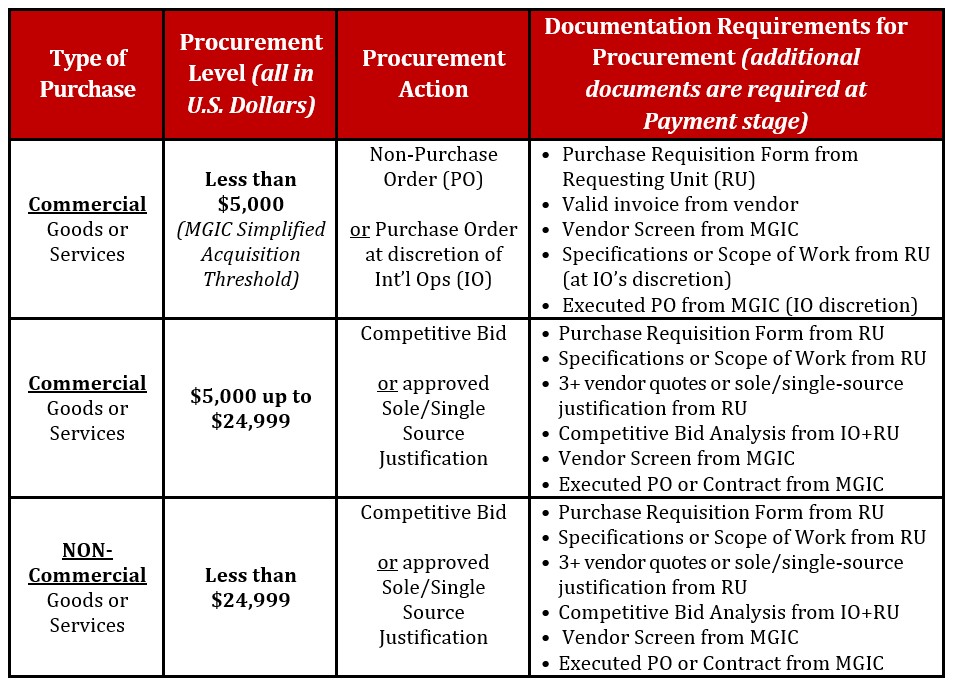
- MGIC shall apply competitive bidding requirements aligned to different categories and financial thresholds of procurement activity to achieve responsible stewardship, risk management, and business efficiency. As of this policy date, thresholds and associated procurement requirements are as follows:
- Commercial Goods and Services under $5,000 U.S. Dollars (USD). This is considered MGIC’s Simplified Acquisition Threshold (SAT). Below this threshold:
- MGIC may, at the discretion of the IO procurement team and with approval by the Assistant Vice President (AVP) - IO (in their capacity as MGIC VP – Policy & Administration), purchase commercial goods and services without collecting multiple quotations and without issuing an MGIC Contract or Purchase Order. This is referred to as a Non-PO payment (See MGIC Non-PO Payment Policy).
- A competitive procurement process and execution of a PO/contract for commercial goods and services under this threshold may nevertheless be warranted if, in IO’s determination, this action would protect MGIC or UMB/Affiliate from undue risk or would ensure the acquisition of lowest-priced technically acceptable services in unfamiliar markets. Based on IO’s determination, MGIC may conduct a competitive procurement process and issue a PO or contract for purchases under the SAT regardless of the allowability of a Non-PO under this policy.
- Commercial Goods and Services at or above US $5,000, and all Non-Commercial Goods and Services regardless of dollar value: Procurements within this threshold require a competitive process with at least three quotations from qualified independent offerors, or an approved Sole or Single Source Justification from the Requesting Unit describing the prevailing conditions that may preclude or render impractical the use of a competitive process (see Sole/Single Source criteria below).
- All goods and services (non-commercial and commercial) at or above US $25,000: Where there is no accepted Sole/Single Source Justification, the MGIC competitive process for purchases at this threshold must include a formal Request for Proposals or Request for Quotations (i.e. an Open and Full Competition), as well as a Competitive Bid Committee and, if appropriate and deemed necessary by the IO procurement team, a Technical Evaluation Committee. To the extent practical, MGIC will advertise RFP/RFQ solicitations in a manner that best meets the needs of the Requesting Unit. These committees and processes are described in the MGIC procurement standard operating procedures.
- Commercial Goods and Services under $5,000 U.S. Dollars (USD). This is considered MGIC’s Simplified Acquisition Threshold (SAT). Below this threshold:
- Split procurements are prohibited. MGIC may not break up invoices or purchases to keep the amount below the competitive bidding threshold or to bypass proper competition and approvals. It is also improper to split a purchase to fall into two different fiscal years.
Summary: MGIC Competitive Bidding Thresholds and Requirements
Exceptions to Limited and “Open and Full” Competition
- MGIC may authorize a non‑competitive or limited‑competition procurement when the requesting unit provides a written Sole or Single Source justification demonstrating that Open and Full Competition is not feasible or not in the best interest of the organization. Acceptable justifications include:
- Sole Source: Only one supplier is capable of providing the required goods or services.
- The supplier is uniquely qualified: the only source of the required goods or services.
- Product specifications, required service certifications or licenses, or delivery times can be met by only one provider.
- Compatibility or standardization of existing supplies or systems is necessary and justified, including to meet technical requirements.
- Other suppliers did not respond to a solicitation despite a good-faith publicity effort.
- Program consultants and other independent contractors for whom the Requesting Unit has received prior approval in writing from a sponsor, or who are provided for in the sponsor award agreement.
- Single Source: Multiple suppliers may be capable of providing the required goods or services, but the buyer (requester) chooses to purchase from one specific supplier for reasons that benefit MGIC, such as assured performance and stable cost.
- Stronger Contractor Relationships: When there is already a long-term trust, enabling better collaboration and shared innovation and values.
- Consistent Quality and Stable Pricing: When the committed contractor delivers predictable quality and pricing.
- Improved Coordination and Delivery: When a known and proven contractor enhances coordination and supports lean systems such as Just In Time or Consignment Stocking.
- Sole Source: Only one supplier is capable of providing the required goods or services.
- A proposed Sole or Single Source Justification from the Requesting Unit shall be accepted or rejected at the discretion of the MGIC VP – Policy & Administration. If rejected, the procurement shall follow a competitive process.
- All requests for exceptions must be reviewed and approved by the AVP – IO in their capacity as MGIC VP – Policy & Administration before any purchase is made. Approval is granted only when the justification is deemed adequate, reasonable, and compliant with this policy.
Prequalified and Approved Vendors
- MGIC may, at the IO division’s discretion, use a process of prequalifying vendors for more rapid procurement of commonly needed goods and services, improved service levels, and cost optimization. Such vendors may be approached for quotes or proposals when a competitive procurement requires capacities or products for which they have been prequalified. Such vendors may also be awarded a fixed-duration Blanket Purchase Agreement (BPA) activated through Call Orders, or another suitable contract instrument, following MGIC’s normal procurement procedures.
- If prior approval for a sole or single-source vendor or service provider is required according to the terms and conditions of a sponsor award, the Requesting Unit must produce such approval in writing before MGIC issues a contract. Failure to secure prior approval may place the university in violation of its award agreement and result in disallowed costs.
Procurement Evaluation
- Evaluation of competitive offers shall include an analysis of cost and value against current known market prices, technical requirements and other predetermined selection criteria, vendor past performance when applicable, and assessment of allowability, reasonableness, and allocability to the intended funding source.
- When determining if a vendor’s bid or proposal is acceptable, MGIC must consider price as well as technical factors such as:
- Compliance with technical specifications
- Quality of the goods or services
- Accommodation of time schedules
- Delivery times
- Payment terms
- Guarantees, warranties, availability of spare parts, after-sales services and training
- Ongoing maintenance and operating costs
- Past experience and performance of the vendor in fulfilling procurement terms
- MGIC shall utilize a Competitive Bid Committee and, where deemed necessary by the IO procurement team, also a Technical Evaluation Committee, for all procurements above the threshold for a full RFP/RFQ, or whenever a specific procurement below the threshold would benefit from these structures, as agreed with the Requesting Unit. The committees’ work and recommendations are documented via a memo, following MGIC’s operating procedures.
- The evaluation of offers and the resulting selection recommendation shall be documented through a Comparative Bid Analysis (CBA) using MGIC’s template, which shall incorporate Bid Committee and TEC input as applicable, and will also include an explanation if fewer than three independent quotations were obtained. The CBA must be approved or rejected by the MGIC Vice President – Policy & Administration as the final determination of the procurement process.
Selection of Instrument
- MGIC maintains several standardized procurement instruments that comply with MGIC policy, incorporate legal counsel review of foundational content, and follow applicable UMB standards when appropriate. These instruments currently include:
- Purchase Order (for commercial goods and services, and for project-specific obligations under an existing institutional partnership agreement)
- Contract for Independent Services (for consultants, research collaborators, advisory and other non-commercial services)
- Blanket Purchase Agreement (for long-term engagements defined by pre-negotiated scopes and costs, and activated through individual Call Orders)
- Contract Modification (to authorize change in scope, duration, and/or price)
- Administrative Action (to activate Option Periods, and to communicate unilateral terminations and other allowable unilateral actions)
- IO personnel will determine the appropriate choice of instrument to achieve the objectives of each procurement.
- Only IO personnel with MGIC procurement responsibilities may alter an MGIC template to meet the specific requirements of a unique procurement.
- IO will obtain legal counsel review of substantive alterations to MGIC procurement templates, standard terms and conditions, and procedural steps to ensure compliance with local laws and business customs.
- MGIC may sign a contract or agreement issued by the vendor inclusive of the vendor’s required terms and conditions for commercial services. MGIC must not accept any vendor terms and conditions that present undue risk to MGIC or UMB/Affiliate or that MGIC cannot comply with as a non-State entity.
Special Considerations
- Independent Service Contractors: When procuring the services of an independent contractor (e.g. consultant), MGIC must:
- Comply with U.S. and applicable labor classification laws governing the distinction between an independent contractor and an employee. See MGIC Human Resources policy for more information about labor classifications.
- Comply with applicable U.S. income tax obligations as an IRS withholding agent.
- Convey obligations for foreign tax compliance to the contractor via the terms and conditions of the MGIC contract, to avoid potential permanent establishment exposure.
- Structure the payment schedule in the MGIC service contract to retain final payment until complete delivery and acceptance of final goods or services, as confirmed by the Requesting Unit. Any exception must be approved by the MGIC VP – Policy & Administration.
- Multi-year commitments: MGIC shall align the end-dates of contracts and purchase orders to the fiscal year of the Requesting Unit, to support sound budget management and institutional or sponsor regulatory compliance. However, if a multi-year commitment is beneficial to the Requesting Unit and a manageable risk to MGIC and the university, MGIC may consider a contract mechanism that allows for incremental obligations of funding up to a maximum contract ceiling. Examples of such mechanisms include an Option Period contract and a Blanket Purchase Agreement.
- Amendments and Modifications: Active contracts and agreements must be amended for any change to the specifications, quantities, nature, scope, duration, cost or compensation of the goods or services provided. Amendments are activated through bilateral modifications, and must follow the same process as the original procurement, beginning with a Change Order Requisition (see MGIC procurement procedures).
- Extensions: MGIC may extend an active contract or agreement prior to its expiry date, upon receipt of a valid and accurate Change Order Requisition Form from the Requesting Unit and supporting scope of work and other information pertinent to the change. The extension is re-assessed for cost reasonableness and technical performance. The extension is issued through a bilateral Modification. Repeated extensions for the same services from the same vendor are discouraged, and MGIC may recommend a Blanket Purchase Agreement as a more appropriate mechanism.
- Expired Contracts: If a contract expires and the Requesting Unit subsequently wishes to renew or extend the period of performance for the purpose of adding additional work to the scope and/or deliverables and increase the contract budget, a new procurement must be initiated through a new, valid Purchase Requisition Form. The procurement must be rebid in accordance with MGIC procedures, and the vendor has the right to renegotiate the cost or price, delivery and performance requirements, and payment terms under a new contract.
- After The Fact actions: An After the Fact (ATF) purchase or commitment occurs when a Requesting Unit obtains goods and/or services from a supplier, or communicates or implies a binding commitment by MGIC to the supplier, before the issuance of a valid, properly procured and executed Contract or Agreement following MGIC’s policies and procedures. An ATF action is non-compliant,violates MGIC, UMB and USM procurement policies, and puts all parties at risk.
- The Requesting Unit must complete an After The Fact Memo describing the purchase, the circumstances, and the Corrective Action to be taken within the Requesting Unit to prevent future ATF occurrences. The Memo must be signed by an authority within the Requesting Unit responsible for enforcing the Corrective Action.
- MGIC has sole discretion to issue an MGIC contract instrument to commit payment for services or goods already provided. The contract, if executed, will be accompanied by an executed Pre-Award Letter authorizing expenses for work completed before the start date of the contract. MGIC contract instruments may not be backdated.
- Any work, expense, or obligation undertaken by a foreign collaborator or other party that is not specifically authorized in a valid, executed MGIC contract is at the party’s own risk. MGIC is not liable to accept or pay for goods or services outside of a valid MGIC contract.
- MGIC reserves the right to suspend or terminate access to future MGIC services for Requesting Units that habitually violate this policy by making purchases or commitments without a valid MGIC procurement instrument.
Procurement File
- MGIC’s official procurement documents shall be maintained in two authorized locations only: UMB’s secure online platform (currently Microsoft 365), and MGIC’s business accounting platform. No procurement documents may be kept on individual computer hard drives, other third-party applications (e.g. WhatsApp), or other unauthorized locations. Access rights shall be restricted to authorized UMB and MGIC personnel responsible for the procurement process.
- MGIC procurement files may be made available in full to authorized UMB/Affiliate personnel outside the IO division, and to third parties such as auditors, when necessary for university policy compliance and approved by the MGIC President.
- Each procurement file shall include a standardized set of executed forms and documents, following MGIC templates and procedural guidance.
Scope
This policy applies to all MGIC, UMB/Affiliate, and third-party personnel who administer, manage, or participate in the MGIC procurement process.
Responsibilities
- IO Procurement staff: Develop, implement, and follow appropriate standard operating procedures to ensure policy compliance, function efficiently, and minimize risk to MGIC and UMB. Escalate cases of non-compliance, known conflicts of interest, unfeasible policy or procedural requirements, and other procurement irregularities to the AVP-IO or to the MGIC President.
- AVP-IO (in capacity of MGIC VP – Policy & Administration): Maintain policies and oversee IO compliance. Serve as approver and signatory as described in this policy and in the MGIC Table of Authorities. Authorize policy exceptions where properly justified.
- Requesting Units: Follow MGIC policies and procedures. Complete required procurement steps, forms, and documents timely and accurately to reduce risk and to maintain positive institutional collaboration with vendors and service providers. Supervise and oversee contracted vendors and service providers to ensure satisfactory performance and quality of goods or services received. Ensure contracted vendors and Service providers understand and follow contractual terms and conditions, as well as applicable sponsor or other requirements. Request Policy Exceptions for legitimate reasons only, and refrain from policy deviations unless and until an exception is approved by MGIC.
Procedures
See MGIC Standard Operating Procedures.
Documentation Requirements
- MGIC Procurement forms and documents as described in this policy and related procedures.
- Change Order Requisition Form
- Change Order Requisition Form
- Change Order Requisition Form
- MGIC Conflict of Interest Certification
- MGIC Non-Disclosure Statement
- MGIC Purchase Requisition Form
- MGIC Table of Authorities
- Purchase Requisition Form
References
- Ethics Hotline
- MGIC Policy on Procurement
- MGIC Policy on Ethics and Conduct
- MGIC Policy on Policy Exceptions
- MGIC Policy on Human Resources
- MGIC Policy on Non-PO Payments
- MGIC Policy on Property Management
- MGIC Policy on Signature Authorities
- MGIC Policy on Use and Administration of MGIC