CHHS leader Markus Rauschecker guides state cybersecurity council at UMB meeting
When the Maryland Cybersecurity Council met Oct. 15 at the University of Maryland, Baltimore, it was led by one of UMB’s own. Markus Rauschecker, JD, executive director of the University of Maryland Center for Cyber, Health and Hazard Strategies (CHHS), chairs the council. It brings together experts from government, business, and academia to advise Maryland lawmakers on cybersecurity, artificial intelligence, and quantum computing.
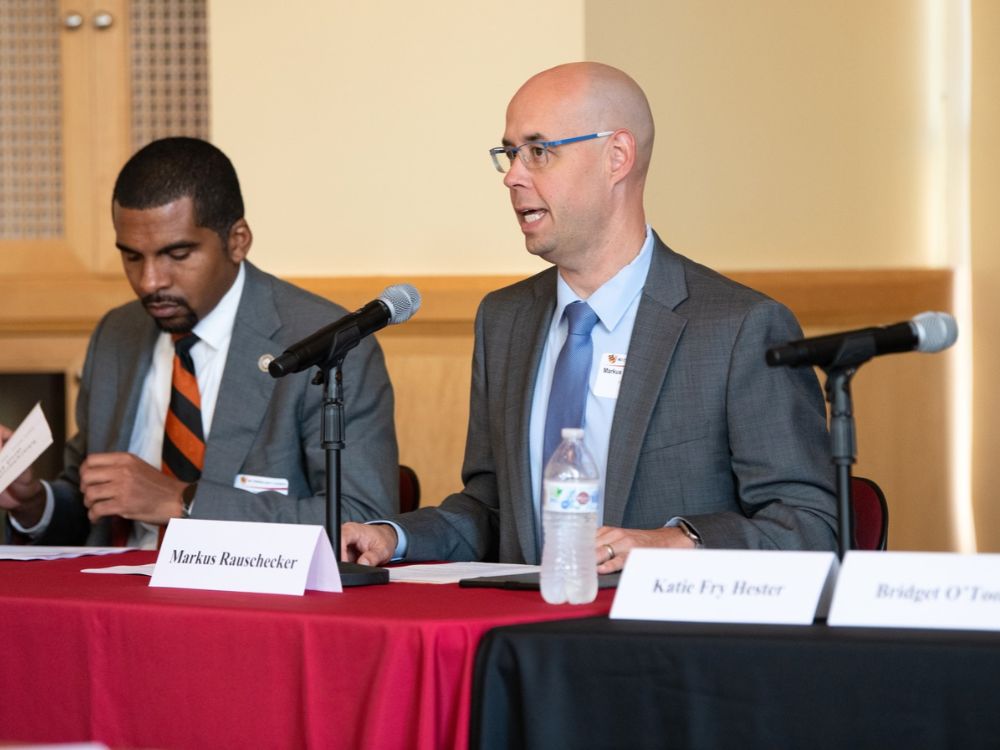
Markus Rauschecker, JD, (center) is chair of the Maryland Cybersecurity Council.
At the meeting held in UMB’s Health Sciences and Human Services Library, Maryland Commerce Secretary Harry Coker Jr., a former White House national cyber director, gave the keynote via Zoom. He praised members for their commitment to the state and challenged them to help define what progress looks like and how it will be measured.
He said Maryland’s universities, labs, and companies give the state “exceptional expertise,” but added that “leadership should be measured by outcomes, not simply by capabilities.”
The council also welcomed two new legislative members, Del. Caylin Young, and Del. Matthew J. Schindler, and heard reports from its five subcommittees, which cover topics from AI accountability to protecting health care systems.
Advising the State
The General Assembly created the council in 2015. Every two years it reports to lawmakers, and its recommendations have helped shape several Maryland laws.
“Maryland wanted a resource of experts” to give the state unbiased recommendations, said Rauschecker, a member since 2017. “These are critical issues that are moving very rapidly. They’re developing very quickly, and sometimes we, as a society, don’t really know yet what the best way to proceed is.”
The Maryland attorney general chaired the council until a 2025 law let members choose their own leader. They elected Rauschecker to serve a two-year term.
Rauschecker’s ties to UMB go back two decades. He earned his law degree from the University of Maryland Francis King Carey School of Law in 2006. He joined CHHS in 2008 and was named executive director in 2025.
CHHS has been part of the council from the beginning. Michael Greenberger, JD, the center’s founder, was an original member. Rauschecker said CHHS brings legal and policy expertise along with practical knowledge from working with clients across the state.
“We understand the practical issues that everyone is dealing with, so we can bring that perspective to the council,” he said.
Because council members are volunteers, they often rely on CHHS law student externs for much of the research and writing.
“All of our externs at CHHS, in some way or another, have been involved with the work of the council,” Rauschecker said.
Training the Next Generation
That student work is part of Maryland Carey Law’s Cybersecurity and Crisis Management Law Program, one of the first of its kind in the country. It lets JD, LLM and Master of Science in Law (MSL) students specialize in cybersecurity. The MSL gives professionals without law degrees legal and policy expertise in the field.
CHHS staff teach many of the program’s courses. Rauschecker is one of them. As a lecturer in law at Maryland Carey Law, he has developed and taught four courses on cybercrime, information privacy, international cybersecurity, and the law and policy of cybersecurity.
Through CHHS externships, students work on real projects for clients such as the Maryland Cybersecurity Council, the Maryland Governor’s Office of Homeland Security, the Federal Emergency Management Agency and the National Security Agency.
According to Rauschecker, the hands on work is not only useful, but necessary. “Today’s technology lawyers need more than legal doctrine,” Rauschecker said. “They need to understand how technology works, how organizations manage cyber risk and how governments are responding to emerging challenges.”
The approach has drawn national attention. In 2026, the National Jurist gave Maryland Carey Law an A+ for technology law, a grade it gave to just 12 law schools nationwide. U.S. Cyber Command also chose it as the first law school in its Academic Engagement Network.