Maryland has taken significant steps to expand the role of physician assistants (PAs), but workforce shortages and barriers to practice continue to limit access to health care. Closing those gaps will require more than legislative reform—it will take stronger training programs, investment in PA educators, and collaboration across the state's health care system.
That was the focus of Health Care Access at a Crossroads, an Oct. 23 forum hosted by the Physician Assistant Leadership and Learning Academy (PALLA) at the University of Maryland, Baltimore (UMB). The livestreamed event brought together clinicians, educators, and policy advocates to examine how Maryland can better use its PA workforce to meet growing patient needs.
Delivering the keynote address was David J. Bunnell, PhD, MSHS, PA-C, DFAAPA, an associate professor and program director of the Doctor of Medical Science (DMSc) program at the University of Maryland School of Graduate Studies (UMSGS) and president and chair of the board of directors of the American Academy of Physician Associates (AAPA).
"Expanding the healthcare workforce remains important, but workforce growth alone will not resolve these challenges," Bunnell said. "We must also consider how care is organized, how knowledge is applied, and how healthcare professionals work together."
Bunnell emphasized that, beyond initial clinical training, preparing health care professionals for the future means supporting their continued education, professional growth, and leadership development throughout their careers.
Removing Barriers to PA Practice
A panel discussion examined Maryland's recent efforts to modernize PA practice laws and allow PAs greater opportunities to use their clinical training.
The panel was moderated by UMSGS Associate Dean Mary Jo Bondy, DHEd, MHS, MSL, PA-C, and featured Deanna Bridge Najera, MPAS, MS, PA-C, DFAAPA, a legislative advocate with the AAPA, and Scott Maucione, a health care reporter with WYPR, Baltimore's National Public Radio affiliate.
Panelists highlighted the state's 2024 PA Modernization Act, which replaced the traditional delegation-of-duties framework with practice-level collaboration agreements, and the 2026 Parity Act, which addressed additional regulatory barriers.
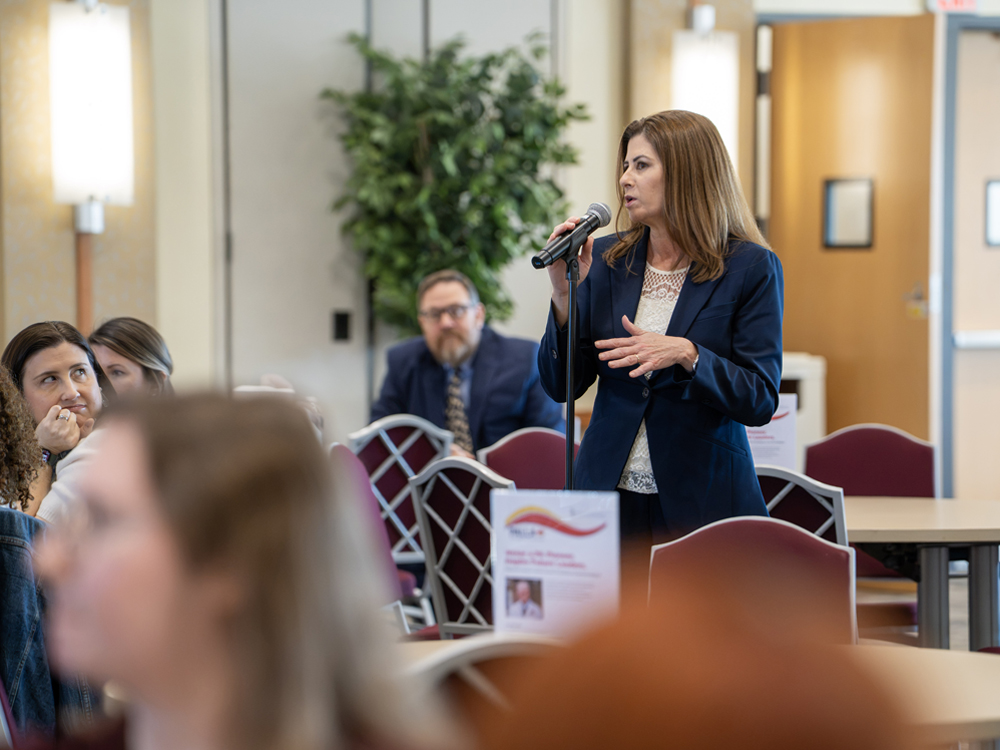
An audience member asks a question during a panel discussion at PALLA's Health Care Access at a Crossroads forum, which explored legislative reforms, workforce challenges, and the future of physician assistant practice in Maryland.
"That was tremendous progress made in 2024 with great support by our senators and delegates," Bondy said. "And then the Parity Act really helped us clean up some language that was serving as a barrier for organizations to optimize PA practice."
Despite that progress, challenges remain. Panelists discussed insurance credentialing restrictions, interstate licensing requirements, and limitations on telehealth that can prevent PAs from providing care to patients who need it.
Gerald Kayingo, PhD, executive director of PALLA and assistant dean for research at UMSGS, said the academy's work extends beyond education to advancing PA practice and improving access to care. That commitment to advocacy extends to PALLA's partner institutions, including UMB, whose faculty, staff, and alumni have helped advance legislation aimed at removing barriers to PA practice.
Kayingo pointed to the recent legislation as an example of that collaboration. PALLA's director of advocacy collaborated with the Maryland Academy of Physician Assistants and state legislators, while UMB faculty, staff, and alumni supported the efforts through letter-writing campaigns and testimony before lawmakers.
Meeting Patients' Needs Beyond the Exam Room
The panel also explored how changes in federal health care policy could affect Maryland's health care system, including new Medicaid eligibility requirements scheduled to take effect in 2027.
Maucione discussed the potential for insurance coverage losses to place additional pressure on hospitals and emergency departments already struggling with overcrowding and lengthy wait times.
PAs can help relieve some of that pressure by providing care in primary care and urgent care settings, where patients can receive treatment for conditions that do not require emergency services.
Bridge Najera urged PAs to become more involved in health care policy discussions, bringing their firsthand experiences with patients to legislators and health care leaders.
"So that's where we really ask you, we need to hear the stories of what it looks like on the ground day-to-day," Bridge Najera said. "How are your patients? How are your practices being impacted so that we can take these stories to the legislators?"
Building the Next Generation of PA Educators and Leaders
For PALLA, improving health care access also means strengthening the educational infrastructure needed to prepare future generations of PAs.
When the academy was established, Maryland's PA programs faced challenges involving accreditation, faculty shortages, leadership development, student success, and the availability of clinical training sites. PALLA responded by developing programs to strengthen PA education and cultivate new educators from within the profession.
“Our graduates are helping shape the future of physician assistant education, bringing their clinical expertise into faculty roles and preparing the next generation of health care professionals,” Kayingo said.
The academy also launched a Student Success Institute to provide coaching, advising, and preparation for national certification examinations. According to Kayingo, all Maryland PA programs are now fully accredited, with student examination performance above the national average and attrition below the national average.
To address shortages of clinical preceptors, PALLA has developed partnerships with universities and hospitals across the state, hired regional coordinators, and secured grants to support clinical education, particularly in rural communities. Its preceptor fellowship helps practicing clinicians develop the teaching skills needed to train PA students and postgraduate residents.
Those investments are already making a difference, according to Katy Hines, PA-C, MS, MBA, executive director for Advanced Practice at Johns Hopkins Medicine.
"The value of our partnership with UMB through PALLA extends across our practicing PA workforce, the students we help educate, and our postgraduate PA residency programs," Hines said. "Investing in our clinicians as educators strengthens all three."
Hines said fellowship graduates have become more effective at teaching, providing feedback, and assessing learners' development. They also have gained confidence as educators and built professional relationships with colleagues at other institutions.
The benefits extend beyond the classroom.
"Those relationships can create a pathway from clinical student to postgraduate trainee to colleague," Hines said. "Collaboration between institutions is particularly valuable because it connects educational expertise with clinical practice and allows the benefits to reach beyond an individual fellowship participant."
Recognizing Excellence in the PA Profession
The event also featured the Maryland Academy of Physician Assistants' (MdAPA) 2026 awards, recognizing PAs for their contributions to patient care, education, advocacy, and community service. Honorees included:
- Evie Wollman Scholarship: Namra Fiaz, a student in UMB's Physician Assistant Program at UMSGS - Recognized for academic excellence, community involvement, clinical performance, and leadership, including serving as class president of her PA program.
- Rising Star Award: Tiffany Passie, MA, MPH, MPAS, PA-C - Recognized for early-career clinical excellence, leadership, and service.
- PA Educator of the Year: Nicole Heidenreich, MSPAS, PA-C - Honored for her mentorship and work developing future PAs through Johns Hopkins' emergency medicine training programs.
- Humanitarian and Service Award: Carey Roesler, PA-C - Recognized for expanding access to care for underserved Baltimore communities, including through free physical examinations for student-athletes.
- Maryland PA of the Year: Kelly Schutz, PA-C, CAQ-EM - Honored for her leadership, mentorship, and advocacy for legislation advancing PA practice in Maryland.
You Might Also Like


 Research Innovation and Integrity
Study Provides Reassuring News for Women Using Medications to Treat Opioid Use Disorder During Pregnancy
November 1, 2026