


Fighting Infectious Diseases, Advancing Vaccines, and Protecting Public Health
For much of American history, infectious diseases were among the nation’s greatest threats. Smallpox, tuberculosis, cholera, yellow fever, influenza, and countless other diseases shaped daily life, claimed millions of lives, and challenged physicians who often had few effective tools at their disposal.
Over the past 250 years, however, the story of America also has been a story of scientific progress. Through research, medical education, public health, and innovation, the nation transformed its ability to understand, prevent, and combat disease.
At the University of Maryland, Baltimore (UMB), that story has unfolded for more than two centuries.
From treating wounded soldiers during the Civil War to helping lead vaccine research during the COVID-19 pandemic, UMB has played a role in many of the defining public health challenges of U.S. history.
When Davidge Hall opened in 1812, the causes of most infectious diseases were still unknown. Physicians had not yet accepted germ theory. Antibiotics did not exist. Vaccines were limited, and outbreaks of infectious disease were common.
Students at the College of Medicine of Maryland learned in an era when epidemics routinely swept through American cities and communities.
As Baltimore grew into one of the nation’s largest ports, physicians trained at the college increasingly confronted diseases arriving from around the world. Their experiences helped advance medical understanding and prepare future generations of health professionals to respond to emerging health threats.
Caring for a Nation at War
During the Civil War, faculty and graduates of the University of Maryland served on the front lines of military medicine. Physicians treated traumatic injuries, infections, and diseases that often claimed more lives than battlefield wounds. The conflict highlighted the importance of organized medical care, sanitation, and disease prevention — lessons that would influence public health and medical practice for decades to come.
By the late 19th century, scientific breakthroughs were transforming medicine. Researchers began identifying bacteria and understanding how diseases spread. Hospitals increasingly became centers of both treatment and scientific inquiry.
UMB grew alongside those advances.
In 1918, as World War I drew to a close, the world faced another devastating challenge: the influenza pandemic. The Spanish flu infected an estimated one-third of the world’s population and killed millions worldwide. Baltimore was among the U.S. cities affected by the outbreak.
At UMB, physicians, nurses, students, and hospital staff joined health care workers across the nation in caring for patients during one of the deadliest public health crises in modern history. The pandemic reinforced the importance of surveillance, public health infrastructure, scientific research, and medical education — principles that continue to guide disease prevention efforts today.
From Treatment to Prevention
The 20th century brought extraordinary advances in vaccines and infectious disease research. Diseases that once devastated communities — including polio, measles, diphtheria, and many others — became preventable through immunization.
At UMB, researchers increasingly focused not only on treating disease but also on understanding how to prevent it. That commitment helped establish the University as a leader in vaccine development and global health research.
In 1974, the University of Maryland School of Medicine established the Center for Vaccine Development (now the Center for Vaccine Development and Global Health), launching what would become one of the world’s leading vaccine research enterprises.
For more than 50 years, CVD researchers have helped develop and tested vaccines and other interventions against some of humanity’s most persistent and dangerous infectious diseases, including malaria, typhoid fever, cholera, shigella, respiratory viruses, and emerging global health threats.
Their work extends far beyond Maryland. Researchers collaborate with partners around the world to improve health outcomes in vulnerable populations and strengthen global preparedness against future pandemics.
The center’s contributions have helped shape vaccine science, clinical trials, disease surveillance, and public health policy on an international scale. From field sites around the globe to laboratories and clinical trial centers in Baltimore, CVD has become a cornerstone of UMB’s mission to improve health through discovery.
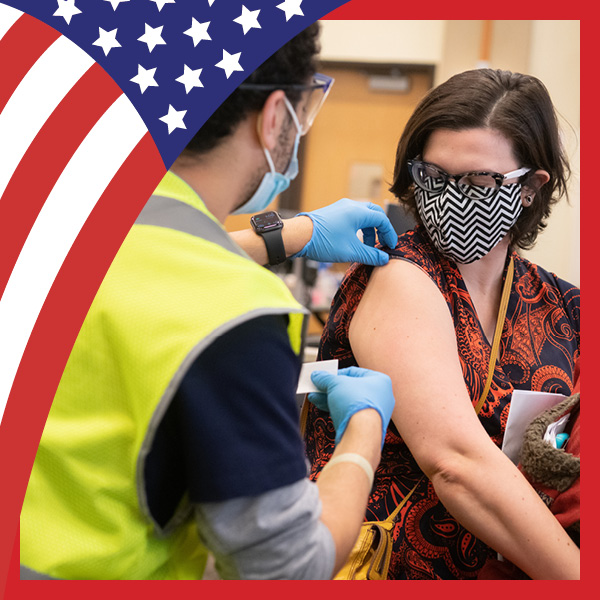
A vaccine clinic was held in the Health Sciences and Human Services Library each year.
Responding to COVID-19
When COVID-19 emerged in 2020, UMB again found itself confronting a defining public health challenge. Researchers, clinicians, faculty, students, and staff mobilized rapidly to support the response.
Scientists participated in vaccine research and clinical trials. Public health experts helped inform policy decisions and community outreach efforts across the country. Clinicians cared for patients during an unprecedented health crisis. Researchers worked to better understand the virus and develop new tools to combat it.
The pandemic demonstrated both how much had changed since 1918 and how important continued investment in science and public health remains. What once took decades can now happen in months. Vaccines can be developed faster. Diseases can be tracked in real time. Researchers can collaborate globally in ways that earlier generations could never have imagined.
Yet, the fundamental mission remains the same: protecting human health.
Preparing for the Next Threat
UMB researchers continue to address emerging infectious diseases and future pandemic threats. Scientists are advancing new vaccine technologies, studying respiratory viruses, developing malaria interventions, evaluating novel monoclonal antibodies, exploring universal influenza vaccines, and improving strategies to detect and respond to outbreaks before they spread.
At the same time, they are training the next generation of physicians, nurses, pharmacists, dentists, social workers, lawyers, and public health leaders who will confront the health challenges of the future.
As the United Staes marks the 250th anniversary of the Declaration of Independence in 2026, UMB’s history reflects the remarkable progress of a nation that moved from an era when infectious diseases were poorly understood to one in which science can identify, track, and combat emerging threats with unprecedented speed and precision.
From Civil War hospitals to the Spanish flu, from the founding of CVD to COVID-19 and today’s cutting-edge vaccine research, UMB has helped advance knowledge, train health professionals, and protect communities.
The diseases may change. The technologies will continue to evolve. But the mission that began more than 200 years ago remains constant: improving lives through discovery, education, and service.