

UMB Hosts Historic Announcement as Maryland Becomes an AARP Age-Friendly State
The University of Maryland, Baltimore (UMB), Maryland’s first Age-Friendly University, welcomed state leaders, advocates, and community partners to 4MLK at the University of Maryland BioPark on July 28 as Maryland officially became an AARP Age-Friendly State. With this recognition, Maryland joins a growing national network committed to creating communities where people of all ages can thrive.
Maryland Secretary of Aging Carmel Roques selected UMB as the site for the announcement in recognition of the University’s longstanding leadership in advancing age-friendly education, research, and community initiatives. The designation builds on Maryland’s recently enacted Longevity Ready Maryland Act, a statewide framework designed to help ensure that Marylanders can live longer, healthier lives while aging with dignity.
“This day is really about joining the AARP Age-Friendly Network, and the work that we will do with them will make it real in the local communities to be age-friendly,” Roques said. “It won’t just be policy. It won’t just be planning. It will be action.”
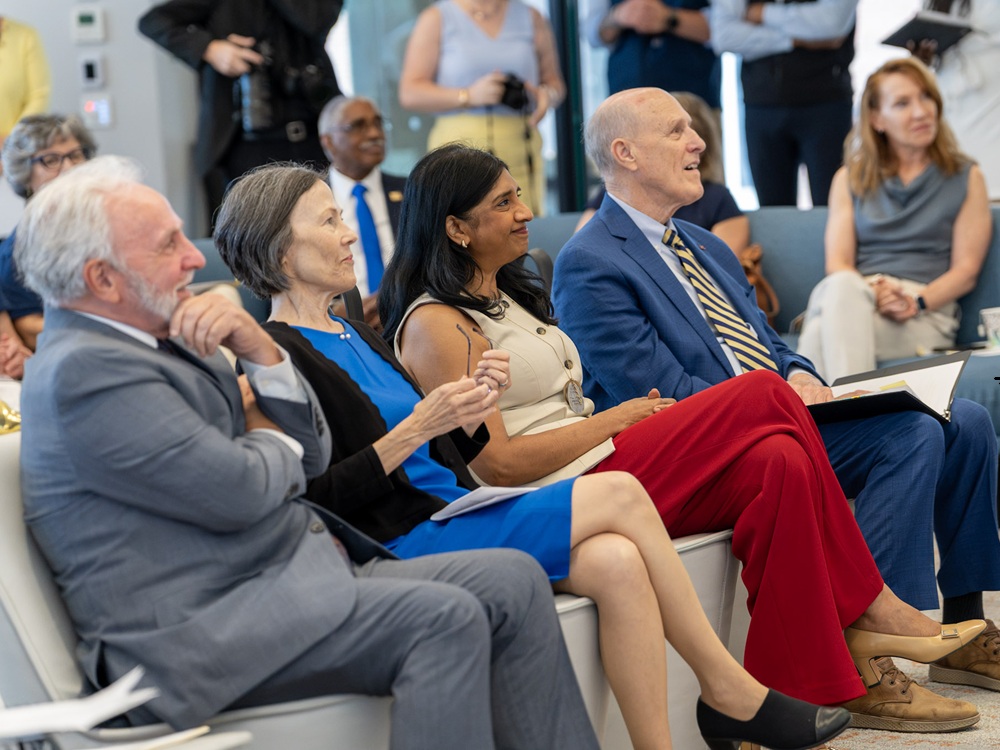
From left: Hank Greenberg, state director, AARP Maryland; Carmel Roques, secretary, Maryland Department of Aging; Aruna Miller, lieutenant governor of Maryland; and Bruce E. Jarrell, president, University of Maryland, Baltimore, listen to a speaker during the Age-Friendly Maryland ceremony.
The AARP Age-Friendly Network encourages states and communities to improve housing, transportation, public spaces, health care, social engagement, and other factors that support people throughout their lives. Maryland’s designation commits the state to long-term improvements that help residents remain healthy, connected, and engaged at every stage of life.
Lt. Gov. Aruna Miller said the designation reflects Maryland’s commitment to designing communities that benefit everyone.
“Preparing for an aging population isn’t just about doing more for older adults, it’s about building communities that work better for everyone,” Miller said.
Miller also recognized UMB as Maryland’s first Age-Friendly University, highlighting the University’s commitment to lifelong learning and interdisciplinary collaboration.
That commitment is reflected across the University. UMB’s schools educate future physicians, nurses, pharmacists, dentists, lawyers, and social workers to address the needs of an aging population, while researchers advance knowledge in gerontology, geriatrics, healthy aging, and age-related disease. Through its community partnerships and programs, UMB also works to improve the health and well-being of older adults throughout Baltimore and beyond.
“A university’s actions are its priorities. Actions show our priorities,” UMB President Bruce E. Jarrell, MD, FACS, said before highlighting the University’s broad range of aging-focused research, academic programs, and community initiatives.
Among those efforts, the University of Maryland School of Graduate Studies (UMSGS) is home to graduate programs in gerontology and the Geriatrics and Gerontology Education and Research program, which prepares health professionals to better serve older adults through interdisciplinary education and collaboration. The school is also home to the Entrepreneurship and Science Communication for Aging and Age-Related Research fellowship, which equips aging scholars to broaden the reach and impact of their work.
“Secretary Roques’ decision to hold this announcement at UMB reflects the University’s longstanding commitment to advancing research, education, and community partnerships that improve the lives of older adults,” said Kenneth Wong, PhD, UMSGS dean and vice provost for graduate education, UM . “Through interdisciplinary collaboration, we are preparing the next generation of researchers, clinicians, educators, and policymakers to meet the opportunities and challenges of an aging society.”
The event also featured remarks from Hank Greenberg, AARP Maryland state director, who called the designation “more than a milestone” and “a statement” that Maryland is committed to ensuring that people can “live well, contribute, and thrive at every age.” Mike Watson, AARP’s national director of livable communities, welcomed Maryland as the 15th state to join the AARP Age-Friendly Network and noted that it now includes nearly 1,100 communities nationwide.
Del. Heather Bagnall, chair of the Maryland House Health and Government Operations Committee, said the designation reflects years of collaboration among state agencies, local governments, health systems, advocates, and community organizations. She described the Longevity Ready Maryland Act as an opportunity to build communities that help people remain healthy, connected, and independent throughout their lives.
Maryland’s designation builds on a statewide network that includes eight Age-Friendly Communities, more than 30 Age-Friendly Health Systems, and three Age-Friendly Universities. By hosting the announcement, UMB underscored the vital role higher education plays in advancing research, educating the workforce, and partnering with communities to help Marylanders live longer, healthier lives.