

Global Health Summit 2019
.png)
May 28-30, 2019
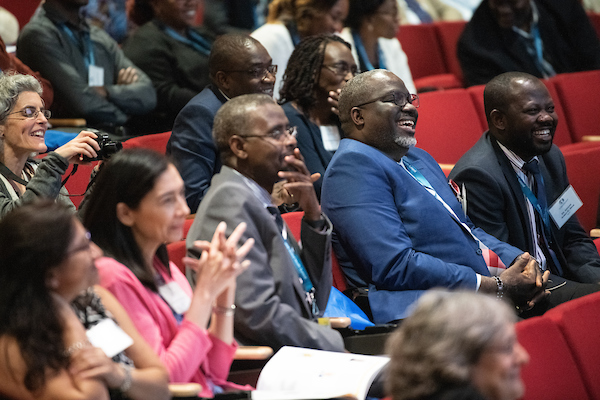
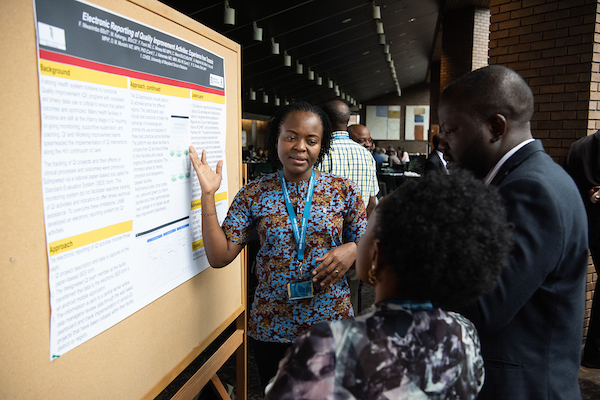
Putting aside differences in time zones, cultures, and professional disciplines, international teams of researchers and clinicians met in Baltimore from May 28 through May 30 to share their previous work and to plan for the future.
The University of Maryland, Baltimore (UMB) held its inaugural Global Health Summit to make strides toward improving the human condition through collaborative health and human services globally. UMB’s Center for Global Education Initiatives (CGEI) was the sponsor.
The main event, held May 29, featured two keynote addresses by international leaders with firm ties to UMB as well as six panel discussions. (View a video below and a photo gallery on Facebook .)
President Jay A. Perman, MD, said it felt “gratifying and humbling,” to greet several hundred people from nine different countries, “all part of one big UMB family working to advance health, well-being, and justice on a global scale.”
In introducing the first keynote speaker, Perman noted how Jody K. Olsen, PhD, MSW, had led international efforts at UMB in helping to establish CGEI and becoming its first director. In 2018, she was sworn in as director of the Peace Corps, returning to the federal agency to which she has devoted nearly lifelong service.
Olsen called attention in her speech to the fact that a fifth of Peace Corps volunteers work on health projects, including 1,000 in HIV-related projects. “We are a very active part of the work that you do,” she said, acknowledging the large contingent of attendees involved in work globally through the University of Maryland School of Medicine (UMSOM) and its Institute of Human Virology (IHV) .
“The global community is committed to ending the AIDS epidemic by 2030, and in order to do this we need to remain focused on the granular data to ensure we are targeting the right people, in the right places, with the right intervention,” Olsen said. “Through our interdisciplinary approach, we need to see our clients as more than their diagnoses.”
The discussion by a panel of country directors for UMB covered research on malaria and other tropical diseases, but several of the presentations focused on curtailing the spread of HIV/AIDS and achieving viral suppression in patients who are living with HIV. Directors reviewed progress and challenges under grants, which are supported by a variety of funders, including the U.S. President’s Emergency Plan for AIDS Relief (PEPFAR).
One highlight was the description by Gambo Aliyu, PhD, MBBS, MS, interim country director for the IHV Center for International Health, Education and Biosecurity (CIHEB)–Nigeria of the daunting task of conducting what would become the world’s largest HIV/AIDS survey.