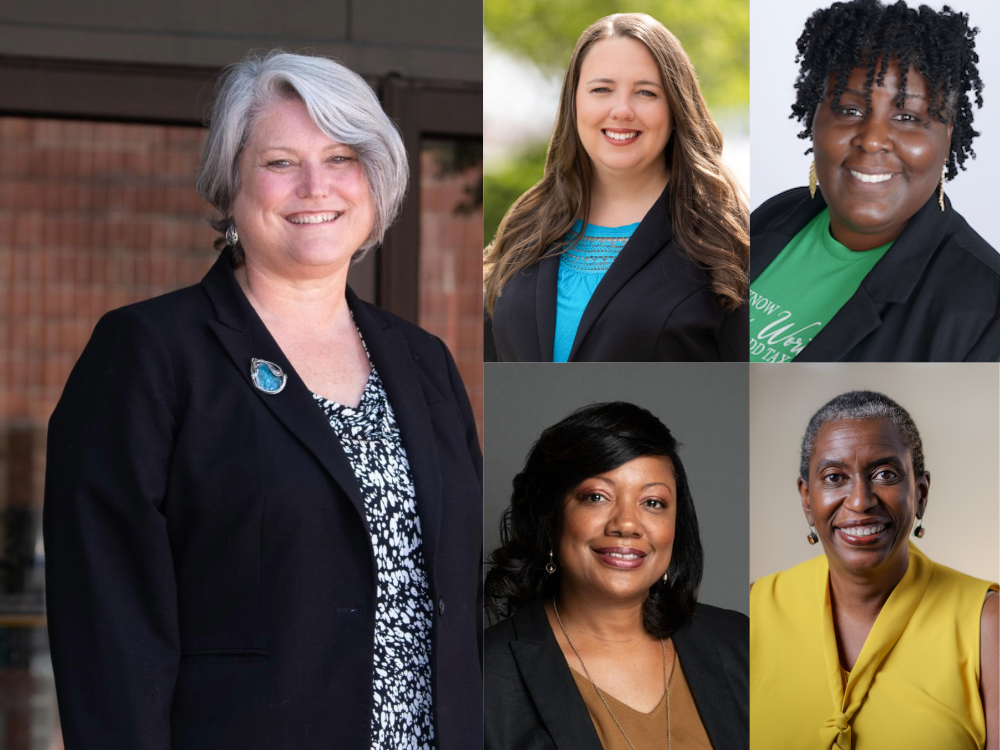


Amid the peak of the HIV/AIDS epidemic, Eric L. Anderson visited Washington, D.C., to view the AIDS Memorial Quilt as it stretched over 30 acres on the National Mall.
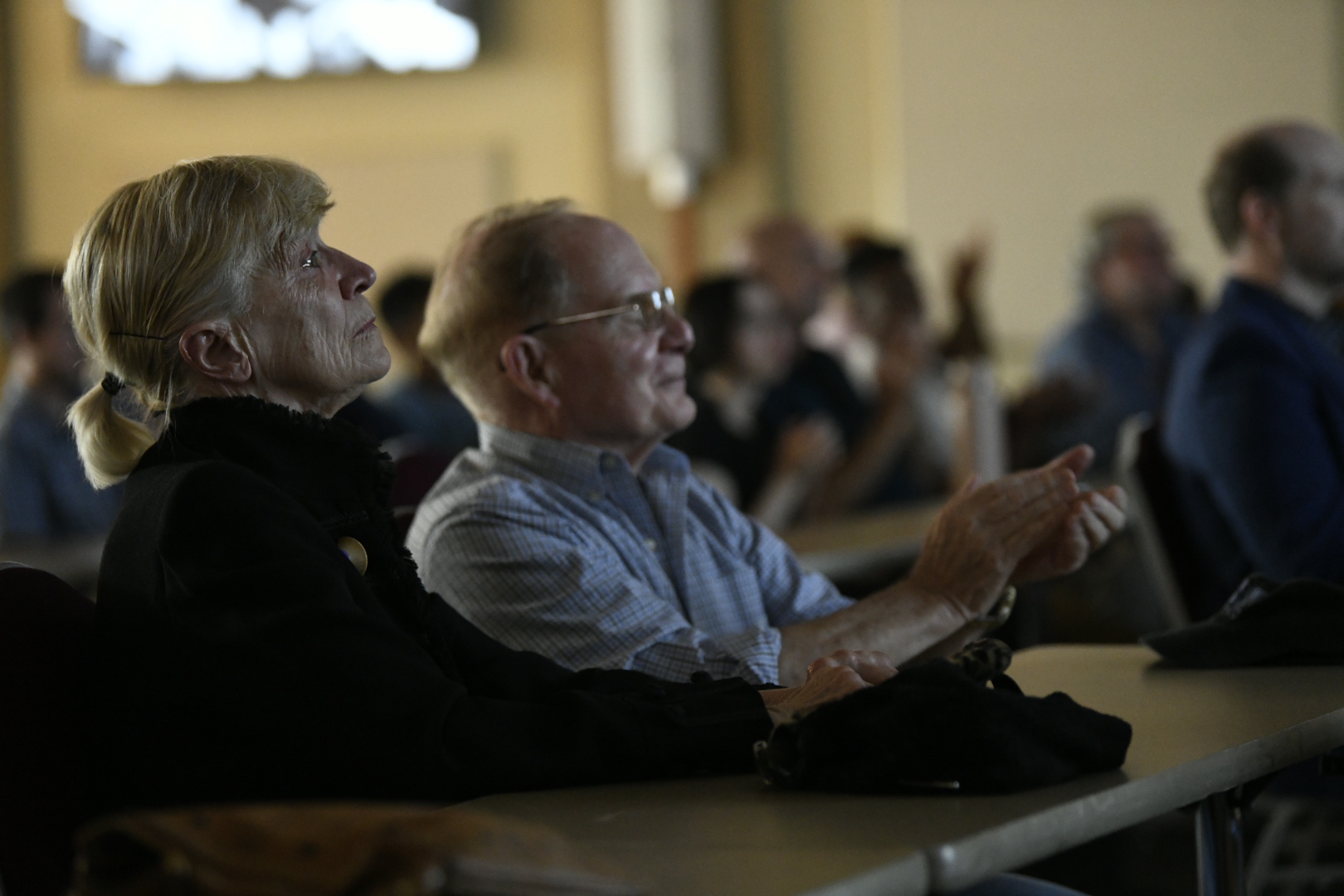
AIDS Memorial Quilt co-founder Cindy "Gert" McMullin, left, watches a screening of "Gert's Boys" at the SMC Campus Center. Photo by Matthew Paul D'Agostino
At that point in 1996, Anderson had lived for five years with an HIV positive diagnosis. The 40,000 panels that laid in front of him represented lives lost to HIV/AIDS.
“I was looking at it, and wondering, who’s going to make a quilt for me?” an emotional Anderson recalled during the University of Maryland School of Social Work’s (UMSSW) Daniel Thursz Social Justice Lecture on Sept. 17. “I’m blessed because everybody didn’t get to survive as I did.”
Anderson’s survivor journey today includes outreach and advocacy — both as a Ryan White HIV/AIDS eligibility specialist with the University of Maryland School of Medicine (UMSOM) Institute for Human Virology’s (IHV) Together, Healing, Reaching, Inspiring to achieve Victory over illness and Embrace life (THRIVE) Program, and as a president of the Coalition of Baltimore HIV Providers.
His experience was part of a panel during the Thursz Lecture, “Past, Present, and Future: HIV, Gert’s Boys, and the AIDS Memorial Quilt,” which brought together HIV advocates, quilt co-founders, and a filmmaker to reflect on the epidemic’s history and the work that continues today.
Advocacy can take many forms. During the Thursz Lecture, a conversation about the AIDS Memorial Quilt examined how an artistic movement helped turn grief into action to amplify the voices of people living with HIV and AIDS, while bringing that history to life for generations of health professions and law students.
The event featured a screening of an award-winning documentary short, “Gert’s Boys,” that tells the story behind the AIDS Memorial Quilt and its first volunteer, Cindy “Gert” McMullin, who is considered the mother of the quilt that was conceived by activist Cleve Jones in 1987. The panels, the film explained, are considered her boys.
In addition to Anderson, McMullin was joined by quilt co-founder Mike Smith and the film’s director, Sara L. Schwartz, PhD, MSW, MA, associate professor of teaching at the University of Southern California Suzanne Dworak-Peck School of Social Work. Schwartz also serves on the National AIDS Memorial board of directors.
“We are so deeply honored to have people here who represent caring and empathy,” said Corey S. Shdamiah, PhD, LLM, LLB, the Daniel Thursz Distinguished Professor of Social Justice at UMSSW, highlighting the panelists as models for the UMB community to learn how to help people in ways that are meaningful.
Remembering AIDS in Baltimore
The average birth year of a UMB student is 2000, meaning that most students training to be social workers, doctors, dentists, nurses, pharmacists, and lawyers have no living memory of AIDS’ societal impact. Schwartz noted the back story of AIDS going unnoticed for this generation.
“My students don't know this history. My children don't know this history. My children's friends don't know this history,” Schwartz said. “I wanted to share Gert, Mike, and Cleve with the world and the quilt.”
Maryland Carey Law student Kimberly Nguyen was born in 2002 and said that she knew very little about the HIV/AIDS epidemic in her 24 years before the Thursz Lecture.
“I didn’t know what the AIDS quilt was until I attended the lecture,” Nguyen said, adding that the quilt was one of the most “powerful works of art I’ve ever seen.”
For social workers, advocating for others is a core value, lending a natural connection to Schwartz’s classes.
“This film is about Gert becoming an activist through the lens of four men she loved and cared for while they were dying,” Schwartz said. “That's really what it's about. It's about her evolution as an activist.”
Students at least have a frame of reference of what the fear of an unknown infectious disease can do because of the coronavirus pandemic. While the impact in numbers was different, the AIDS/HIV epidemic created a fear and persecution of the gay community.
“If you remember your fear of COVID, multiply that by three, and that was our fear,” Anderson said.
The AIDS and HIV epidemic of the 1980s and 1990s hit Baltimore hard, especially the Black community. By the mid-1990s, about three-quarters of AIDS deaths in Baltimore were in the Black community, said Anthony Amoroso, MD, professor at UMSOM and director of the IHV Clinical Community Health Programs.
In 1995, Baltimore recorded 895 deaths among residents who had progressed to AIDS, the deadliest year of the city’s epidemic, according to Maryland Department of Health data.
“During that period, an HIV diagnosis would be a devastating, awful, painful illness followed by death,” Amoroso said. “It happened in a relatively short period of time. Families lost their children. They lost their infants, their parents, their brothers and sisters, and they lost their partners, and their friends and entire communities lost people they really needed.”
From Protest Banner to Art
Not only did McMullin watch friends die around her in San Francisco, but they passed away while being isolated, shunned, and forgotten.
“I was going to hospitals and all — it just wasn’t enough,” said McMullin, who added later she hopes that the quilt teaches love and compassion.
Attending the first meeting proposing to form a quilt gave her and Smith hope.
“We weren't medical professionals, but we all had this overwhelming sense of having to do something,” said Smith. “And it became a tool for activism. It became a tool to express love. But for many of us, it was saving us personally at the time, to have something to do.”
Before the love, Smith said he recalled the anger he felt.
“We were calling it a quilt that felt more like a protest banner,” Smith said.
Expecting spray-painted bed sheets, a call for quilts turned up 1,000 stitched 3-foot-by-6-foot panels. The protest banner evolved into a work of art, Smith said. The outpouring of response showed love in multitudes.
“The panel tells the story of the person, but it also tells the story of the relationship,” Smith shared. “It's how the panel maker saw the person. And you see the love. And once that happened, it changed all of us.”
During the Thursz Lecture, 16 panels from the AIDS Memorial Quilt were on display in the SMC Campus Center. Two panels were selected for their UMB ties.
One panel was made for Robert Neil Schwartz, MD ’77, a UMSOM alumnus who worked for Kaiser Permanente at the time of his death in 1984. In 1985, the Whitman-Walker Clinic opened the Robert N. Schwartz, MD House in Washington, D.C, serving as the city’s first home dedicated to caring for people living with AIDS.
University of Maryland Pediatric AIDS (PACE) Program created a panel in 1996, remembering the names of 57 children with blue footprints for boys and pink footprints for girls.
“We have walked with these children and their families and feel these children have left footprints on our hearts on those who have been privileged to have known and loved them,” reads a sign accompanying the quilt block.
History Rhymes with Itself
Schwartz told the audience that a saying about history guides her work: It may not repeat itself, but it often rhymes.
For the AIDS Memorial Quilt's founders, activism sometimes meant protecting the people whose stories they had been entrusted to preserve.
Smith recalled that the original steward of the quilt, The NAMES Project, maintained what became an enormous electronic database containing information about the quilt's panels and the people who made them. That became a concern amid California ballot fights in 1988 over mandatory reporting of people with HIV and proposals that raised the possibility of quarantine.
The database had two copies. On the ballot election night, Smith recalled, Cleve Jones took one out of California to Portland, Ore., while Smith flew with the other to Reno, Nev. They waited for the results.
“If it had passed, we probably would have had armed people coming in to ask for the database,” Smith said. “It was that kind of time.”
For a new generation of social workers and health professionals, the details may be different, but the panelists said the larger obligation remains: understand the forces affecting the people they serve, protect their dignity and access to care, and be willing to advocate when those things are threatened.
The response to HIV also demonstrates what can happen when advocacy is matched by science.
In 1996, Robert C. Gallo, MD, who had previously helped establish HIV as the cause of AIDS and pioneered development of the HIV blood test while at the National Cancer Institute, co-founded the IHV at UMSOM. The institute brought basic science, epidemiology, clinical research, prevention, and patient care together to accelerate discoveries against HIV and other viral diseases.
That work continues today through research into HIV treatments, work toward a cure, and vaccines. One experimental vaccine developed by IHV researchers, IHV01, progressed from the laboratory into a Phase 1 clinical trial in Baltimore. The first-in-human study found the vaccine candidate to be safe and capable of producing immune responses in participants. No preventive HIV vaccine has yet been approved.
Other UMB research tackles a different part of the problem: making biomedical advances work in people's lives. That includes research examining access and adherence to pre-exposure prophylaxis, or PrEP, which can dramatically reduce the risk of acquiring HIV when taken as prescribed, including one National Institutes of Health-funded study at UMSSW led by associate professor Darren L. Whitfield, PhD, MSW.
Despite the advancements in science and education, Baltimore’s 36.9 new HIV diagnoses per 100,000 in 2024 is nearly three times the national rate of 13.3, according to Maryland Department of Health data. Another way to look at it is that about 1 in every 49 Baltimore residents age 13 years old and older are living with HIV/AIDS. There is more work to do, and that work is tireless.
“HIV is not going to be cured from 9 to 5. It's just not,” Anderson said. “It's not going to be eradicated during office hours.”
Responding to an audience question about avoiding burnout as an advocate, Smith shared that it is inevitable.
“Over 40 years, I have burned out and left and come back five times,” Smith said, but “quilt magic” reminds him why he continues the work.
Smith recalled how a woman wondered aloud before opening how she would find her son’s panel in the 30-acre memorial. She didn’t need a map when the quilt unfolded.
“Her son would sit down at her feet in a sea of 40,000 panels,” Smith said. “We were very blessed because whenever we needed something, the universe provided.”
Some people are just wired to dedicate every day of their lives to a cause. Among them is McMullin.
“Somebody once asked me how I could go in and do this all the time, and I told them as much as they couldn't understand how I could, I couldn't understand how they couldn't,” she said. “I just wanted to do it more and more.”