


Take a moment and consider this observation: “There are things in PDFs that I can’t see as a visually enabled person that they hear in the screen reader. You can hear the screen reader saying something like ‘header, header, header, header’ because it sees all this data in the margins that shouldn’t be there. It can be a jumbled mess.”
That quote comes from Cory Tressler, MA, MAT, assistant dean for technology and digital programs at Ohio State University Libraries. He was interviewed for a recent article in Inside Higher Ed titled “Higher Ed Prepares for a New Era of Accessibility.”

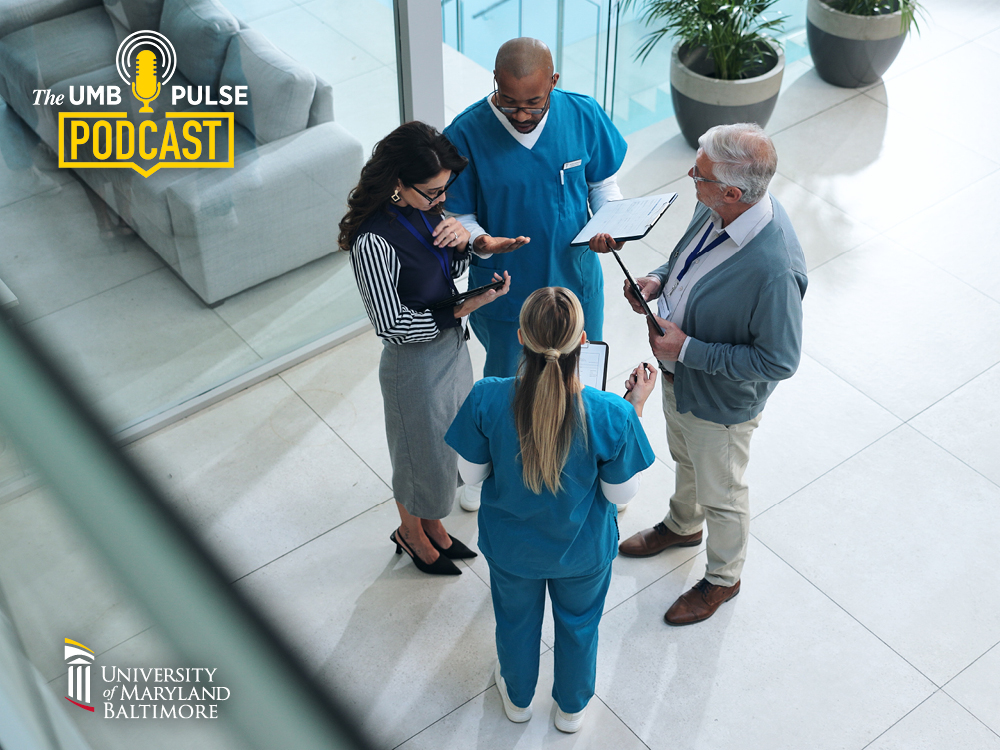
Clockwise from upper left: Emily Hurst, Alex Likowski, Charles Schelle, Amir Chamsaz, Tricia Kaufman, Ann Kim, and Shannon Tucker, with Becky Menendez in the center.
Tressler was describing just one sliver of the challenge facing universities that — along with all state and local government agencies — must come into compliance with federally mandated accessibility standards in April.
The Americans with Disabilities Act of 1990 requires all employers to make reasonable accommodations to employees with any of a wide array of disabilities, and it mandates accessibility requirements for public accommodations. The law has been considered to cover technology access in many ways for years, but in 2024 the Justice Department issued final rules specific to state and local governments’ web content and mobile applications.
All such agencies — including public universities such as the University of Maryland, Baltimore (UMB) — must meet the standards set forth in the latest iteration of the Web Content Accessibility Guidelines. On the federal government’s ADA website, there are examples like this one that help explain the problem:
“Individuals who are blind may use a screen reader to deliver visual information on a website or mobile app as speech. A state or local government might post an image on its website that provides information to the public. If the website does not include text describing the image [usually called ‘alt text’], individuals who are blind and who use screen readers may have no way of knowing what is in the image because a screen reader cannot ‘read’ that image.”
Non-compliant PDF files are clearly a huge problem. There are thousands of PowerPoint slides and information graphics filling up our websites that are in no way compliant with federal law.
Video recordings are another problem area. They need to be captioned properly and may require audio descriptions for visually impaired users.
It’s going to take a lot of effort to fix what’s already out there, and it will take little extra time when we create new content going forward. But it’s really the only way to ensure that everyone, regardless of ability, is able to fully participate in UMB’s academic and community life.
So, it isn’t just the law that requires equitable access, but also UMB’s own core values. Most of the requirements can be met just by doing things like explaining what’s on the screen and speaking clearly — in other words, just by being considerate of people with different abilities.
On March 24, members of the UMB Title II Task Force held a virtual town hall to explain the situation, what’s being done at the University, and answer questions from the UMB community. You can watch the 90-minute program at the top of this webpage or on YouTube.
You Might Also Like

 Excellence in Teaching
Dr. Sandra Quezada to Receive Maryland Hispanic Leadership Award
August 27, 2026


