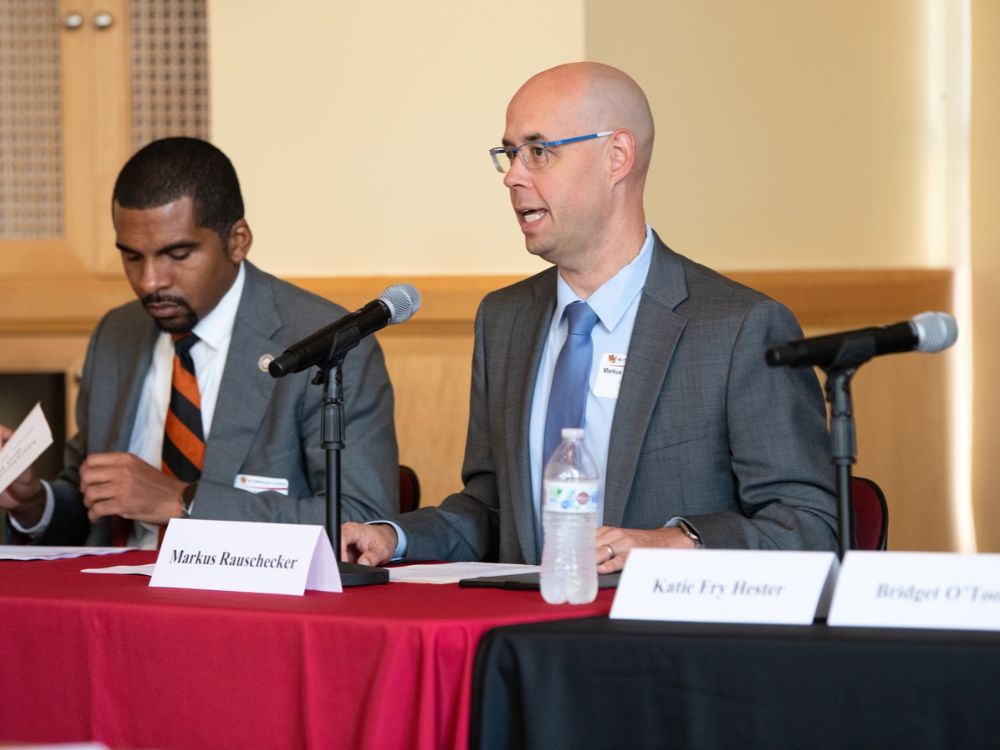


UMB Students Transform Lived Experiences into Innovative Ventures at Grid Pitch 2026
For many of the students gathered inside the Grid, the University of Maryland, Baltimore (UMB) hub for student entrepreneurship, Grid Pitch was about more than presenting a business idea — it was about solving problems they had experienced personally.
One student developed a platform to help families navigate difficult end-of-life medical decisions after watching his own family struggle during his father’s cancer diagnosis. Another created a home monitoring system inspired by his grandmother’s desire to age independently with dignity and privacy. Others pitched ventures inspired by experiences with foster care, burnout, inequities in mental health care, and barriers to education and wellness.
Those ideas were part of this year’s Grid Pitch, held April 23. Featuring the largest student cohort in the program’s history, the showcase gave UMB students the opportunity to develop and present entrepreneurial ideas after weeks of mentorship and coaching from business leaders and innovators.
“This is not a competition; this is a celebration,” said Taylor DeBoer, MA, acting director of the Grid. DeBoer noted that this year marked the ninth pitch event since the Grid opened in 2017 and estimated that the program has awarded approximately $150,000 in student funding over the years.
Grid Pitch 2026 included 12 student ventures spanning two categories: Vision, for early-stage ideas still taking shape, and Venture, for more developed concepts already moving toward implementation. Participants received seed funding to help move their ideas forward, with Vision teams receiving $2,000 and Venture teams receiving $2,250.
During opening remarks, Kenneth Wong, PhD, dean of the School of Graduate Studies and vice provost, encouraged students to use their ideas and expertise to address real-world problems and improve communities through innovation.
“This is an investment in you as scientists, as innovators, as engineers — as people who will do discovery and push the boundaries of knowledge and make the world a better place,” Wong said.
“It is not simply the creation of companies,” he added. “It’s really about how you look at your life and how you look at the things in front of you, the challenges that you face as a society, and how you help with the solutions that make society better.”
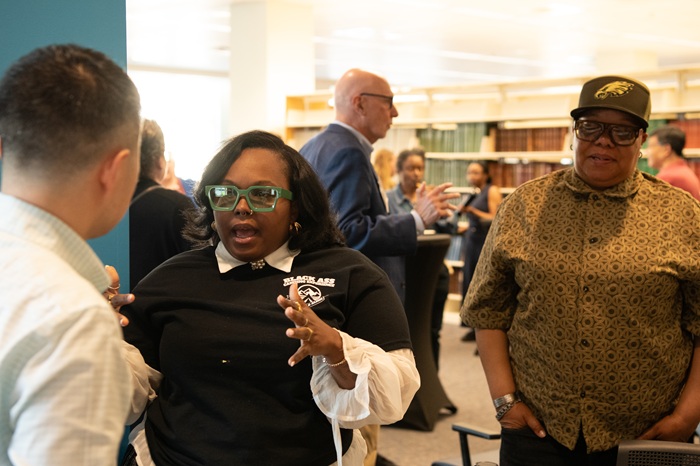
Jade Nesbitt discusses her venture, BACE, with attendees during the networking session following Grid Pitch 2026.
The event also featured remarks from Kelsey Abernathy, PhD ’19, CEO of Baltimore-based startup studio Early Charm and a participant in the first and second Grid Pitch events. Abernathy reflected on how the Grid Pitch helped shape her entrepreneurial career after she and co-founder Dan Fucich, PhD ’19, pitched an early version of what became AlgenAir, a company that uses algae-based technology to improve indoor air quality.
“The Grid was the first time that I ever pitched a business plan, and honestly, it was terrifying,” Abernathy said. “But participating in that pitch was a turning point in my career.”
The ventures presented at the 2026 event reflected a wide range of ideas and experiences across UMB, with students tackling challenges in health care, biotechnology, education, mental wellness, and community engagement.
The Grid Pitch 2026 participants are:
VENTURE
iMPILO Therapeutics: Martin M. Sikhondze, University of Maryland School of Medicine
iMPILO Therapeutics is a biotechnology venture focused on developing next-generation therapeutics using artificial intelligence (AI)-powered platforms to engineer protein-based treatments for autoimmune diseases and cancer. The company aims to reduce the cost of treatment while maintaining the effectiveness of current therapies.
BACE (Black Ass Camping Experiences): Jade Nesbitt, School of Social Work
BACE is an outdoor wellness initiative designed to create safe, community-centered outdoor experiences for Black communities. The program seeks to increase access to nature, adventure, and wellness opportunities through guided group experiences and community engagement.
Benign: Kevin Tu, University of Maryland School of Medicine
Benign is a biotechnology startup that uses cancer mutation data and AI to design new proteins for applications in drug development and sustainable industrial chemistry. The company’s approach seeks to create scalable and cost-effective alternatives for pharmaceutical and industrial use.
ESTHER: Christopher Tong, University of Maryland Francis King Carey School of Law
ESTHER is a privacy-focused home monitoring system for older adults that uses thermal imaging and environmental sensors to detect falls and other safety risks without cameras or wearable devices. Inspired by Tong’s grandmother, the system is designed to help older adults age independently while preserving dignity and privacy.
VISION
Anchor: Julian Bolanos, University of Maryland School of Medicine and Robert H. Smith School of Business
Anchor is a mobile-first platform designed to simplify advance care planning and help patients document critical medical decisions before a medical crisis occurs. The platform streamlines the process of creating and securely sharing advance directives with health care providers and family members.
Nange: Amanda P. Nsubugua, University of Maryland School of Medicine
Nange is a storytelling and community-centered platform designed to support stigma-free conversations around sexual and reproductive health among African women in the diaspora. The platform aims to provide culturally sensitive education, shared experiences, and accessible resources.
The Fabulous Life Wellness Collective: Asia Malik, School of Graduate Studies
The Fabulous Life Wellness Collective is a therapeutic event company that combines wellness education, mindfulness, and community-building experiences to make mental health support more engaging and accessible. The initiative blends therapy-informed programming with creative and social experiences.
Power and Purpose Leadership Program: Terrena Williams, School of Social Work
The Power and Purpose Leadership Program is a nonprofit initiative focused on helping youth aging out of the foster care system build independent living, vocational, and leadership skills. The program aims to provide mentorship, life-skills training, and opportunities for long-term stability and success.
The CLC (Community Literacy Café): Churon Lanier-Martin, University of Maryland Francis King Carey School of Law
The Community Literacy Café is a café-based literacy initiative designed to provide after-school tutoring, reading support, and mentorship opportunities for Baltimore City students. The community-supported business model uses café sales and sponsorships to help fund literacy programming.
Harmony Healing Hub: Augustina Quesada, School of Social Work and Robert H. Smith School of Business
Harmony Healing Hub is a community-centered wellness and retreat model focused on helping adults manage stress, trauma, and loneliness through immersive and group-based healing experiences. The initiative combines mental wellness programming with community-building and long-term support services.
Bedside Manner: Ankush Verma, University of Maryland School of Medicine
Bedside Manner is a hospital workflow platform designed to improve patient flow, care transitions, and communication through a more user-friendly electronic health record interface. The platform aims to reduce emergency department overcrowding and improve efficiency for health care workers.
REAL digitizED: Tarrin Morgan, School of Graduate Studies
REAL digitizED is an esports- and technology-driven workforce development initiative that helps underserved youth build digital media, branding, and career-readiness skills through gaming and creative technology experiences. The program connects students to career pathways in gaming, media, and technology.
MaYé: Sophie Ogunsanmi, University of Maryland School of Medicine
MaYé is a biotechnology-powered clothing venture developing adaptive garments that intelligently redistribute body heat based on environmental conditions and the wearer’s needs. The technology is designed to improve comfort, wellness, and performance across health care, lifestyle, and occupational settings. Ogunsanmi did not pitch during the event but participated as part of this year’s Grid Pitch cohort.
For many participants, Grid Pitch represented more than an opportunity to present a business idea. The event gave students the chance to refine their concepts, connect with mentors and entrepreneurs, and explore how their personal experiences and academic training could translate into solutions with real-world impact.
For Tong, whose venture ESTHER was inspired by his grandmother's desire to age independently, the program helped turn personal experience into a practical solution.
“The most valuable part of Grid Pitch was being encouraged to innovate and excel and being given the tools and resources to do so,” he said. “Drawing on my observations caring for older family members, and lectures on entrepreneurship organized by Grid Pitch, I learned how to translate my personal experiences and legal training into a project that addressed real-world issues.”
Nesbitt said the experience similarly helped her think about how to grow BACE beyond a passion project.
“Grid Pitch revived my business,” Nesbitt said. “Grid Pitch motivated me to consider my passion as a business and offered tangible ways to execute that. After Grid Pitch, I feel more confident as a business owner and now feel empowered to invest in myself and apply for other grants.”