


During America’s 250 years, love seems to have conquered all, but relationships and democracy both require work to be everlasting, especially for interracial and interethnic couples.
The intersection of American culture and these marriages are at a center of a new book authored by University of Maryland School of Social Work researchers.
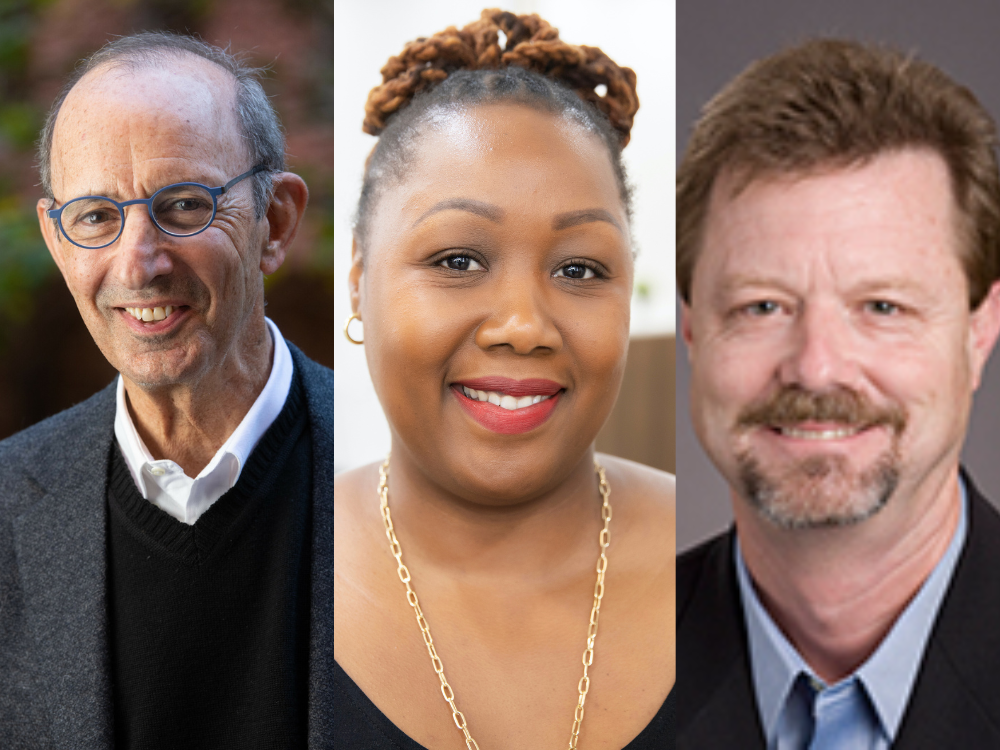
Authors and researchers Geoff Greif, Victoria Stubbs, and Michael Woolley
America’s history is filled with cultural flashpoints and violence where race and ethnicity are front and center. The June 12, 1967, landmark decision, Loving v. Virginia, struck down state laws banning interracial marriage, and nearly 60 years later, some couples continue to be judged.
From 2020-2025, these married partners living through events like the murder of George Floyd, or Asian American, Pacific Islander, and Jewish hate crimes arising from COVID-19 and extreme rhetoric, among others, forced interracial and interethnic couples to understand what their partners experience as they wrestled with the rest of the world for acceptance.
“Despite what's been going on in the country for the last five years, they're optimistic,” said Geoffrey L. Greif, PhD, MSW, Distinguished University Professor Emeritus at the University of Maryland School of Social Work (UMSSW). “They think their marriages are going well."
In a newly released book that builds upon their published research, “Interracial Marriage: How Diverse Couples Navigate Relationships in a Divided Time,” Greif, along with private clinician and UMSSW instructor Victoria D. Stubbs, LICSW, LCSW-C, RMT, and retired UMSSW professor Michael E. Woolley, PhD, interviewed over 150 married interracial and interethnic couples and surveyed 428 people about navigating their relationships from 2020 to 2025.
Released by Columbia University Press, the book examines how couples navigate identity, race, parenting, politics, family expectations, and public scrutiny in an increasingly polarized environment. The authors say many of the lessons extend far beyond race.
“Clinicians need to know how to work with this next wave of potential clients,” Greif said. “But we're also trying to get that broader scope up here to how can this appeal to anybody that wants to understand race relations better in the United States.”
Findings From Interviews and Surveys Conducted for Interracial Marriage
|
Finding |
Result |
|
Couples interviewed/surveyed for the book |
Over 150 |
|
National survey respondents |
428 |
|
Couples optimistic about the future for interracial families |
Over 75% |
|
Couples who said others immediately perceive them as interracial/interethnic |
70% |
|
Couples visibly perceived as interracial were more likely to discuss race during conflicts, avoid certain places, and seek therapy |
Yes |
Source: Interviews and surveys conducted by Geoffrey L. Greif, Victoria D. Stubbs, and Michael E. Woolley between 2020-2025 for “Interracial Marriage: How Diverse Couples Navigate Relationships in a Divided Time.”
The book explores how partners often become aware of racial dynamics they previously never had to consider. White spouses, for example, described recognizing privilege for the first time after witnessing how strangers treated their partner or children. Couples recounted conversations sparked by major national events.
“People come into relationships with blind spots,” Stubbs said. “Sometimes you don’t fully understand your partner’s lived experience until you’re in situations together and you experience it firsthand.”
One woman interviewed for the book described worrying for her Black husband and biracial children in ways she never had before marriage.
“It’s because the level of stress, being a mom who’s up all night thinking about my children, are they going to be OK, and thinking about my husband,” she told the researchers.
Stubbs said those moments often force couples to confront not only external pressures, but also internal assumptions.
That process, she said, is often ongoing.
“The therapist has to be able to listen for the opportunity to be like, ‘OK, wait, what is this about? Can we hear that? And can we together make the connections?'" Stubbs said.
Epiphanies and Education
The growth for these couples come from a mix of education and epiphanies, at times through experience, whether through tragedy or triumph.
The authors also hope the book becomes a resource for therapists and social workers who may feel unprepared to navigate conversations about race and identity in relationship counseling.
Historically, the authors write, many therapy models were developed through a predominantly Eurocentric lens, often leaving therapists ill-equipped to address the realities interracial couples face. The book includes examples from therapy, discussion prompts, and what the authors describe as creating a “brave space” where couples can openly discuss race, fear, identity, and cultural assumptions.
“The blind spots aren't shared because it's painful," Stubbs said. "And so the therapist has to be able to create the safe space and a welcoming space to allow couples to be able to, when appropriate and as needed, bring that in.”
The researchers found that many couples ultimately viewed that work as strengthening their relationships.
More than three-quarters of interracial and interethnic couples surveyed expressed optimism about the future for interracial families. The researchers also found that younger generations are increasingly open to interracial relationships and more comfortable discussing race and identity than previous generations.
Still, the couples interviewed often described carrying an emotional burden others may not see.
Some avoided certain places or family gatherings. Others described the exhaustion of constantly explaining their experiences or defending their relationships.
“We're helping the couple to be vulnerable with each other around these topics that can be very … painful, but they shape who we are and how we move,” Stubbs said.
That is where therapy can become important for couples to hear their partner reveal untold experiences.
In one example from the book, a Black husband initially resisted socializing with white neighbors, frustrating his wife. Only later in therapy did he reveal childhood trauma involving a white neighbor who had repeatedly called child protective services on his family.
As soon as he shared that story, his wife said, “His reactions make more sense,” Stubbs wrote in the book.
Greif said he hopes the examples in the book from an array of couples can help not only move beyond defensiveness and toward understanding, but hopes others understand when talking about interracial and interethnic couples, those terms include a spectrum of identities and experiences.
“There’s no monolithic interracial, interethnic family,” Greif said.
At a time when political and cultural divisions dominate public life, Greif believes these relationships offer something increasingly rare: a model for navigating differences without erasing identity.
"These couples have to work harder to make things work in our society, but they also can provide a way for us all to move forward," Greif said.
Interracial Marriage in the United States
|
National Trend |
Data |
|
Married U.S. couples who are interracial/interethnic |
1 in 10 |
|
Newlyweds marrying across race/ethnicity |
1 in 6 |
|
Asian American newlyweds in interracial/interethnic marriages |
29% |
|
Hispanic/Latine newlyweds in interracial/interethnic marriages |
27% |
|
Black newlyweds in interracial/interethnic marriages |
18% |
|
White newlyweds in interracial/interethnic marriages |
11% |
Sources: U.S. Census and Pew Research Center data cited in “Interracial Marriage: How Diverse Couples Navigate Relationships in a Divided Time.”
You Might Also Like


 Excellence in Teaching
Dr. Sandra Quezada to Receive Maryland Hispanic Leadership Award
August 27, 2026


