

When Baltimore student Layla Cheatham joined WombWork Productions’ Summer Teen Ensemble at the University of Maryland, Baltimore (UMB) Community Engagement Center (CEC), she was used to being the quiet one.
“I was like, ’OK, I’ll just be quiet, just get my stuff done in the corner,’ ” she recalled.
Cheatham, who participated in the ensemble through Baltimore City’s YouthWorks summer employment program, already had some experience with acting through her former elementary and middle school. But over five weeks at the CEC, she found herself doing much more than performing. She researched issues affecting young people, helped shape scenes, and became increasingly comfortable sharing her ideas with others.
By the end of the summer, Cheatham was performing a poem she had written in front of an audience — a sign of just how much had changed in five weeks.
“I’ll definitely use my voice more,” she said. “I feel like this has made me like feel better and more confident in speaking up for myself.”
That transformation was at the heart of WombWork’s YouthWorks program, hosted this summer by UMB’s Office of Community and Civic Engagement (OCCE). The program culminated July 30 and 31 with "What They Don’t See: Youth Incarceration, Resilience, Resistance and Restoration," an original production created and performed by the participating Baltimore youth.
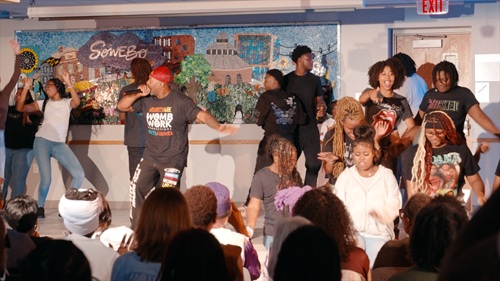
Students perform a scene from WombWork Productions’ "What They Don’t See" at the UMB Community Engagement Center.
Using theater, poetry, music, dance, storytelling, and spoken word, the ensemble explored youth incarceration and the juvenile justice system. As they developed the performance, the young people immersed themselves in real events and experiences, examining the pressures facing their peers and how young people are portrayed and treated within the system. Along the way, they learned to collaborate, advocate for issues they care about, and turn ideas and emotions into art.
For UMB, hosting the program was also an opportunity to connect the University’s work with the perspectives of youth who live in local communities.
Lisa Rawlings, MBA, director of workforce and job readiness for OCCE, noted that UMB’s role in Baltimore extends beyond educating future lawyers, social workers, doctors, nurses, pharmacists, and other professionals or conducting research. As an anchor institution in Southwest Baltimore, she said, UMB also has a responsibility to be a good neighbor and share its resources with the community.
Young people are already an important part of that work at the CEC, which hosts programs including Police Athletic/Activities League (PAL) activities and CURE Scholars, which introduces middle and high school students to careers in health care and biomedical research. Rawlings noted that the WombWork program offered something different: a chance for young people to lead the conversation and share their perspectives on the issues that matter to them.
“Any opportunity to engage young people and to really listen to what they have to say about their lives and their communities is incredibly important,” she said. “And this particular project has given young people the opportunity to share their perspectives on such a critical topic.”
The WombWork project was particularly meaningful given the production’s focus on juvenile justice, an issue that intersects with work across the University. The program gave members of the UMB community a chance to hear directly from young people about how they view the juvenile justice system and the pressures facing their peers.
Rawlings also saw the young people become increasingly confident in expressing those perspectives.
“I've seen over the course of the YouthWorks time how much these students have developed their voice, how much they've become advocates for themselves and their community, and this is exactly what we, as the University of Maryland, Baltimore, should be supporting,” she said.
Diane Marie St. George, MA, PhD, associate professor of epidemiology and public health at the University of Maryland School of Medicine, was among the UMB faculty members in the audience on July 30. She said she arrived expecting simply to watch a performance but quickly found herself drawn into what the young people were communicating.
“I went there expecting to be an attendee, passively viewing performers on a stage, but the production engaged me as a participant experiencing the full range of emotions, from happiness during the musical segments to sadness as we listened to the gut-wrenching stories of children lost to the juvenile justice system,” St. George recalled.
One moment in particular has stayed with her. During a scene, the young performers told the audience that “we don’t live on their street” — a reminder, St. George said, that adults may not understand the pressures young people face or the difficult circumstances that can shape their decisions.
For St. George, the experience also underscored the importance of creating opportunities for members of the University community to listen to the people and communities they seek to serve.
“Our health and human service professions embrace community engagement as a critical component of the work that we do, recognizing that we must engage the voices of the communities we wish to serve in order to truly understand their perspectives and co-create effective, sustainable solutions,” she said. “Creating spaces for this work, like the CEC did, is an excellent mechanism for us to live out the values we espouse.”
Helping young people discover the power in their own voices is central to WombWork’s approach, said Mama Rashida Foreman-Bey, one of the founding directors of the Baltimore social justice theater company, which is approaching its 30th year.
“At first, we had closed little minds, closed mouths, like closed flowers almost, and then something clicked,” she said. “That’s why I do this. That’s why I’ve been doing this for so long, because it’s that turn on that happens.”
The young people weren’t simply handed a script. They contributed poems, stories, scenes, ideas, and feedback and were encouraged to bring their own personalities and experiences to the production. Foreman-Bey said the material incorporated real stories and factual information, including experiences WombWork encountered through its work with young people in detention centers.
“It is not Mama Rashida’s truth. It is our collective truth,” Foreman-Bey said.
She also said that creating an environment where young people felt comfortable expressing themselves was an important part of that process — and one that extended beyond WombWork’s staff. She said the OCCE created a welcoming environment at the CEC where the young people felt supported and that they belonged.
“Our young people felt welcome here,” she said. “We connected. We felt connected to everybody, and that’s important.”
For Cheatham, the summer offered a powerful example of what community engagement can look like at UMB: creating a space where a young person who once preferred to stay quietly in the corner could find her voice and discover that she could make a difference.
“I can start my own movement now,” she said.
You Might Also Like
 Local and National Impact
Baltimore Foster Youth to Get a Dental Home at the School of Dentistry
July 15, 2026