


Respect and Integrity: Highlighting the People Behind UMB's Everyday Operations
What does it mean to truly see and value the people whose work makes it possible for a university community to function every day?
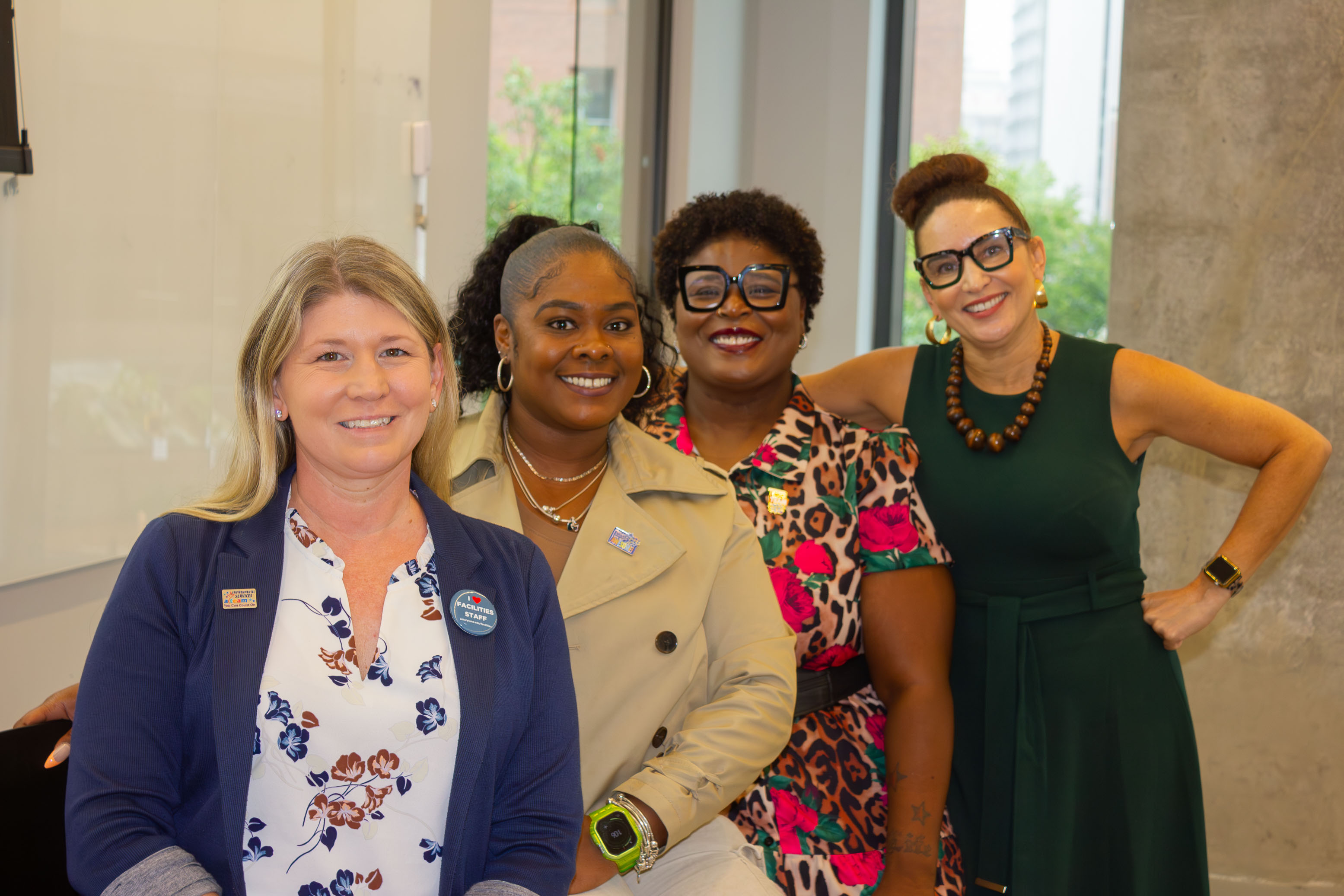
That question was at the heart of the September Values in Action Speaker Series, where Nicole Palmore, executive director of Administration and Finance Employee and Organization Success; Denise Meyer, Environmental Services director; Keisha Blake, Environmental Services senior manager; and Kyra Franklin, day shift grounds manager, shared candid reflections on respect, integrity, recognition, and the essential contributions of employees whose work often happens behind the scenes.
Throughout the conversation, the panelists highlighted the many ways Environmental Services employees care for UMB’s campus and community, often extending far beyond what might be visible in their day-to-day responsibilities.
As Franklin emphasized during the discussion, it is the often-invisible work of Environmental Services employees that allows other members of the UMB community to do their jobs and the University to function each day.
One story shared during the conversation brought that commitment vividly to life.
When a University of Maryland, Baltimore (UMB) student sat down in the middle of a campus street during a moment of personal distress, Edward Taylor, a member of UMB’s Environmental Services team, stopped what he was doing.
Taylor noticed that the student’s parents had joined him in the street, placing all three in the path of oncoming traffic. Rather than continuing with his assigned responsibilities, Taylor immediately began redirecting traffic to keep the student and his family safe.
For Taylor, it was simply the right thing to do. For his colleagues, it was a powerful example of the care, compassion, and integrity that EVS employees bring to their work every day.
Focused on the UMB Core Value set of Respect and Integrity, the panelists invited members of the UMB community to consider how everyday interactions, organizational practices, and opportunities for recognition can help ensure that every employee feels seen, heard, and valued.
Looking Beyond Titles and Credentials
Palmore opened the discussion by asking attendees to consider the letters that often appear after a person's name in an academic setting.
Known as postnominals, these letters represent academic degrees, professional certifications, and other credentials. While acknowledging the importance of education and the accomplishments these credentials represent, Palmore challenged attendees to consider how titles and educational attainment can influence perceptions of an individual's value within a university community.
“What happens when you have no postnominals?” she asked. “What happens, then, in academia? How do they feel? How do they get recognized? How do they get valued?”
Palmore, who has worked at UMB for nearly 10 years, emphasized that staff members provide essential continuity to the University, often remaining in their positions for decades and helping sustain its operations through changes in leadership, faculty, and student populations.
Yet, through her conversations with staff across campus, she has heard experiences of employees feeling overlooked, disregarded, or invisible.
“Here today, we want to talk about respect and integrity, and how that is true for every member of the UMB community,” she said.
Rather than speaking solely from her own perspective, Palmore wanted to create space for employees whose experiences are not always represented in campuswide conversations.
The three EVS panelists offered firsthand perspectives on the importance of their work, the challenges they have encountered, and the ways in which members of the UMB community can contribute to a more respectful and supportive workplace.
Environmental Services is responsible for maintaining approximately 6.3 million square feet of space across 57 buildings and 65 acres. Its responsibilities include custodial services, moving and recycling, special events, grounds maintenance, pest control, and clean campus initiatives.
While much of this work occurs outside the spotlight, its impact extends throughout the University, supporting the daily activities of students, faculty, staff, patients, and visitors.
The Importance of Being Seen and Heard
When Meyer joined Environmental Services as director a little more than six years ago, one of her first priorities was to listen.
Working with University leadership, she conducted focus groups with employees to better understand their experiences, identify opportunities for improvement, and determine how she could support their professional growth and well-being.
The conversations revealed a recurring concern: Employees did not always feel that their work or their presence was acknowledged.
“People will walk right past me and not even look at me or say hello,” Meyer recalled hearing from staff members.
One employee's description of feeling repeatedly disregarded made a particularly lasting impression on her.
Meyer recalled the employee stating “You want to know how I feel? I feel like I’m the gum on the bottom of a person’s shoe, that they step on it, and continue to step on it, and step on it, and step on it.”
The experience reinforced Meyer's commitment to ensuring that employees had opportunities to share their perspectives and that their concerns were heard and addressed.
“We can often listen, but do we actually hear what people are saying?” she asked.
Since then, EVS has implemented several initiatives intended to strengthen employee recognition, professional development, and opportunities for advancement.
These include an internal Employee of the Month program, a Wheel of Gratitude initiative, Team of the Season recognition, and annual EVS Appreciation Week activities.
The department also participates in International Cleaning Week, providing opportunities for EVS employees to connect with members of the campus community, share information about their work, and highlight their contributions to maintaining a clean, healthy, and safe environment.
In addition, EVS has established a career ladder within its Custodial Services Division, creating opportunities for employees to advance through positions such as Custodial Technician II and Custodial Lead.
Meyer also discussed the importance of professional titles and the department's transition from the term “housekeeping” to Environmental Services, including the adoption of the custodial technician job title.
She explained that some employees felt the previous terminology diminished the professional nature of their work.
“We are working professionals, all of us, in their own right and respect,” Meyer said.
Although the department has made progress, Meyer emphasized that building a culture of respect and appreciation requires ongoing attention from the entire University community.
“Without a lot of the services, the essential services that folks in facilities and operations, public safety, and others provide, we may not have our operations running every day,” she said.
Recognizing the Person Beyond the Position
For Blake, one of the most difficult aspects of serving as a senior manager is witnessing the talents and potential of employees being overlooked because of their job titles.
“The hardest part about being a senior manager, wearing this role at UMB, is watching capable, intelligent people get filtered by the narrow lens of their job title,” she said.
Blake explained that EVS employees bring a wide range of experiences, interests, and aspirations to their positions. Some are pursuing academic degrees while working full time, others already hold degrees, and some have chosen careers in Environmental Services because they genuinely enjoy the work.
For some, their position represents an opportunity for professional advancement or a stepping stone toward another career. For others, it provides stability for themselves and their families.
Regardless of their individual circumstances, Blake emphasized that every employee deserves to be recognized as a colleague and valued for the contributions they make.
She also described the experience of employees who feel invisible during everyday interactions but become highly visible when taking a break or using a common area.
Blake shared that EVS leadership sometimes receives calls questioning why an employee is sitting in a particular location or how long the employee has been there, even when that person may simply be taking an authorized break.
The experience raises important questions about how assumptions regarding job responsibilities and organizational status can influence the way employees are treated.
“Do you say hello? Do you acknowledge the people that are actually bringing the building to life, essentially?” Blake asked. “Those are your colleagues. They're not just someone that's cleaning these fixtures and walking around. They're your colleagues. They work alongside you.”
Palmore highlighted the recently opened the WISER Together Lounge in the Saratoga Building as one example of how UMB is working to create spaces where employees feel welcome and supported.
The lounge provides a shared space for members of the University community, regardless of their position or whether they wear a uniform. It also includes private telephone booths, giving employees who may not have individual offices a place to make personal calls.
Palmore encouraged attendees to consider how they could help create similarly welcoming environments within their own schools, departments, and workspaces.
Integrity in Action, Even When No One Is Watching
Franklin expanded the conversation by highlighting the care and responsibility that EVS employees bring to their work, including responsibilities that may not appear in their formal job descriptions.
She explained that employees are often among the first to notice potential safety concerns, maintenance issues, or situations in which a member of the campus community may need assistance.
“We're looking out for you all,” she said. “It's important to us to make sure that we are the eyes of the campus.”
Taylor's response to the student in distress was one example of this commitment.
Franklin explained that although Taylor was carrying out his regular duties when he encountered the situation, he recognized an immediate need and took action to protect the student and his family.
His willingness to respond reflected the broader sense of responsibility that Franklin sees among her colleagues.
“Being a part of healthcare, it's not just people who take care of patients,” she said. “Being a part of healthcare, it's just people who take care of people.”
Franklin also discussed the role that EVS employees play in UMB's relationship with the surrounding community.
Through their daily work, employees interact with individuals from a wide range of backgrounds, including people experiencing homelessness who may spend time near campus because they feel safe in the area.
Franklin encouraged attendees to consider the circumstances and experiences of individuals they encounter rather than making assumptions about them.
“My answer is that we just show them the same respect that we would want,” she said.
Meyer noted that partnerships between EVS, Public Safety's COAST program, and other University departments help connect community members with resources and support.
These efforts demonstrate how employees whose primary responsibilities involve campus operations can also contribute to UMB's broader commitment to community engagement and service and UMB’s mission to improve the human condition.
Turning Conversation Into Action
As the discussion concluded, the panelists encouraged attendees to consider what they could do differently in their own interactions with colleagues.
For Meyer, that means being willing to advocate for others, particularly when someone may not feel comfortable speaking up for themselves.
“We're all held accountable to respect and integrity here at the university,” she said. “Let's, like we've said multiple times, put those values in action, truly. We're talking about it. Now, what are we gonna do about it?”
Palmore challenged attendees to pay attention to how individuals are treated within their own work environments and to speak up when they witness someone being dismissed or minimized.
She also encouraged simple acts of inclusion, such as greeting colleagues by name, getting to know employees who work in their buildings, and inviting them to participate in workplace celebrations and gatherings.
“We are one community at UMB,” Palmore said. “UMB is moving in beautiful ways, we're living into our values, and this is an area where we all can make such a dramatic impact to make sure that every member of our community matters.”
The conversation continued with audience members reflecting on the importance of recognizing the contributions of employees across all areas of the University.
One attendee emphasized that respect and integrity extend beyond acknowledging colleagues in passing. They also involve collaborating with staff, recognizing their professional expertise, communicating directly with appropriate team members, and holding one another accountable for how individuals are treated.
Another attendee shared a personal experience of receiving encouragement from an EVS employee during a difficult day, illustrating how even brief interactions can have a meaningful impact on someone's sense of belonging and well-being.
The discussion reinforced that Respect and Integrity are not values demonstrated only through significant decisions or extraordinary acts of service. They are reflected in the everyday choices that shape how people experience their workplace and their relationships with one another.
In closing, Stacey Rose, UMB's Core Values Program Director, reminded attendees that the work of Environmental Services makes it possible for every member of the University community to access and use campus spaces.
“That's what allows everyone to have access to our spaces,” Rose said. “We cannot physically function without them.”
For Taylor, that commitment meant stopping his work to protect a student and his family. For the broader UMB community, it can begin with something as simple as acknowledging a colleague, recognizing their contributions, or choosing to speak up when someone is being treated without respect.
The Values in Action Speaker Series was created to recognize the ways that all members of the UMB community bring to life the hallmarks of our community. Members of the UMB community are encouraged to continue exploring the University's core values through the Core Values Conversation, UMB Reads!, and future Values in Action Speaker Series events.