

What Happens After Cash Welfare? Maryland’s Longest-Running Study Has Answers
A new report from the University of Maryland School of Social Work (UMSSW) provides an unprecedented look by any U.S. state at how the same people move through cash assistance programs before and after they receive help as opposed to aggregate-only data.
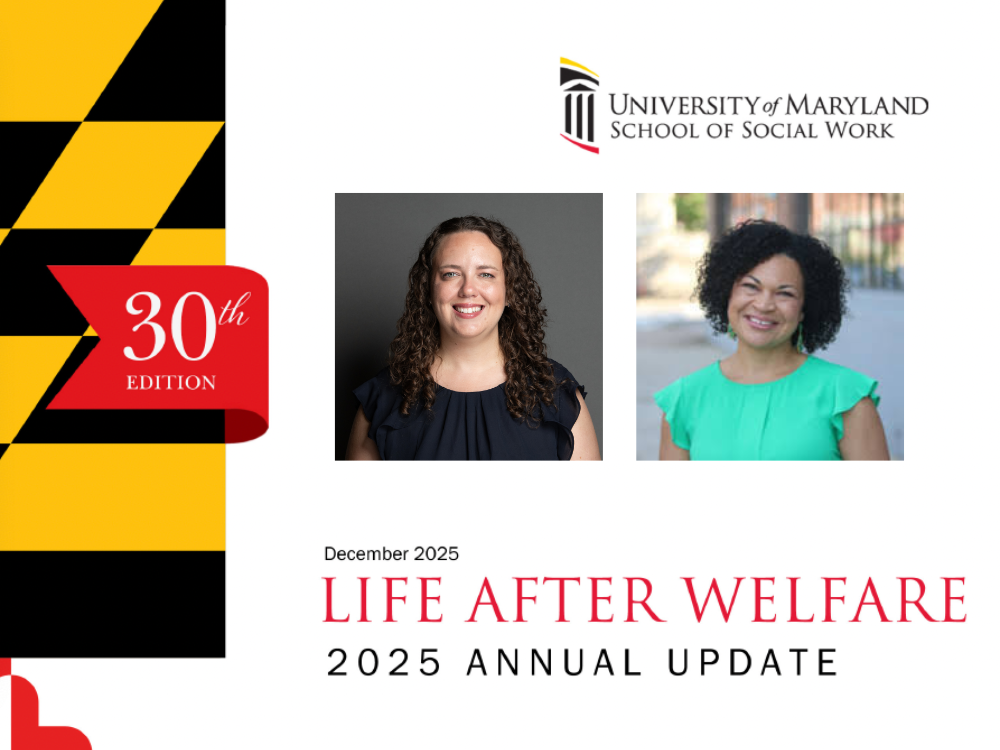
UMSSW’s Lauren Schuyler and Letitia Logan Passarella co-author the annual “Life After Welfare” report.
The “Life After Welfare: 2025 Annual Update” follows more than 42,000 adults who exited Maryland’s Temporary Cash Assistance (TCA) — Maryland’s version of the federal Temporary Assistance for Needy Families program — between state Fiscal Years 2020 and 2024. In addition to comparing different groups of people at different moments, researchers tracked changes within individuals. This shift reveals how employment and earnings evolve over time.
“It reveals the actual trajectories of those leaving cash assistance, showing how employment and earnings evolve for the same person before entry and after TCA exit,” said Lauren A. Schuyler, PhD, assistant research director of the UMSSW Family Welfare Research and Training Group, who is the lead author of the report. Individual progress can be masked through aggregated averages.
“We were able to see who had certain types of changes in employment — not just whether or not they were employed,” Schuyler said. “Did they move from having partial employment throughout the year to full employment? Did they have partial employment, and they then have no employment after they left?”
Maryland is the only state to have publicly tracked welfare leavers (recipients who leave TCA) for nearly three decades. UMSSW has partnered with the Maryland Department of Human Services (DHS) since 1997 for the “Life After Welfare” report, analyzing comprehensive administrative data sets on cash assistance. Using DHS administrative data, the report examines cases of 42,459 adult recipients.
“For 30 years, Maryland has shined on a light on what happens to families after leaving TCA,” said Letitia Logan Passarella, MPP, research director of the UMSSW Family Welfare Research and Training Group and co-author of the report. “This year’s report goes even further — tracking individual families to better understand those journeys. This insight is critical for shaping policies that support economic stability.”
Work Is the Norm, Not the Exception
“Life After Welfare” challenges political and racist false narratives about who relies on the cash welfare program and what their life looks like. One of the report’s clearest findings counters a persistent misconception that most people who leave cash assistance are not working.
“The report refutes two misconceptions: that most welfare leavers remain disconnected from work, and that there is a ‘culture’ of refusing employment obligations that is associated with certain demographic groups,” Schuyler said, referring to a policy position authored by New York University professor Lawrence M. Mead that endorses a theory that behavioral and cultural norms discourage steady work as opposed to structural and administrative constraints.
At least 61 percent of leavers were employed in the year after exit, an increase from the year before they entered TCA. Much of that growth came from full-year employment, not short-term or sporadic work.
“The big picture is that earnings remain low and earnings remain low for a couple of reasons,” Schuyler said. “Partial employment is one of the reasons for low earnings, and the sectors in which folks are employed are another reason for low earnings.”
Nearly seven in 10 families received TCA for a year or less before exiting, highlighting that the program is a short-term support for families and children. Even after leaving cash assistance, most families continue to rely on supports like Medicaid and the Supplemental Nutrition Assistance Program, according to the report. The findings reflect how far wages in many of Maryland’s largest industries still fall short of meeting basic needs.
Some participants in the TCA program are employed in Maryland’s top sectors including retail, accommodations, food service, and health care. The state doesn’t capture occupational classification codes like other states to better understand the jobs people hold within these industries.
“If our economy here in this state is based on these sectors such as retail trade that pay non-living wages, then it makes sense that some of our lowest income, most vulnerable community members are going to be employed in some of these sectors,” Schuyler added.
One limitation of the study is that the administrative data does not capture all employment outcomes. Specifically, the data does not reflect jobs with employers who do not pay unemployment insurance taxes. That includes workers such as independent contractors or gig workers. Nor does the data capture employment secured outside of Maryland. This is particularly important given that Maryland’s out-of-state employment rate is roughly four times the national average, meaning some individuals counted as not working could be employed in neighboring states or Washington, D.C.
“It’s not actually fair to say that 27 percent aren’t employed,” Schulyer said. “It’s a smaller percentage than that. But what percentage it is, we don’t know, and there’s not really a way to figure it out with the current way things are.”
The report also breaks down outcomes by race and ethnicity, showing clear results.
Black leavers had the highest employment rates in the years following exit, as well as the strongest employment continuity and increased or consistent earnings from before entry to after exit. However, they experienced the lowest median earnings, reflecting broader wage inequities.
“That combination tells an important story,” Schuyler said. “People are working. The issue is the quality and compensation of that work.”
Why This Study Stands Apart
As state policymakers navigate the Maryland General Assembly’s legislative session this year, the findings offer a reminder: Most families use cash assistance briefly, most are working, and many still struggle, not for a lack of trying but instead because low-wage work remains the backbone of the economy.
These annual reports are used by the Maryland Department of Legislative Services to provide context to the Maryland General Assembly for legislative oversight and analyses of the DHS budget. This helps lawmakers understand if there is appropriate funding for families.
“ ‘Life After Welfare’ offers something special: consistent evidence on what happens after families leave cash assistance,” Logan Passarella said. “These insights help policymakers understand that economic stability is complex and targeted interventions are vital.”