

CHHS Simulations Help Marylanders Prepare for the Worst
When the tornado touched down in East Baltimore early Thursday morning, ripping the roof off their headquarters and flooding their server room with stormwater, Housing Authority of Baltimore City (HABC) officials had seconds to make critical decisions.
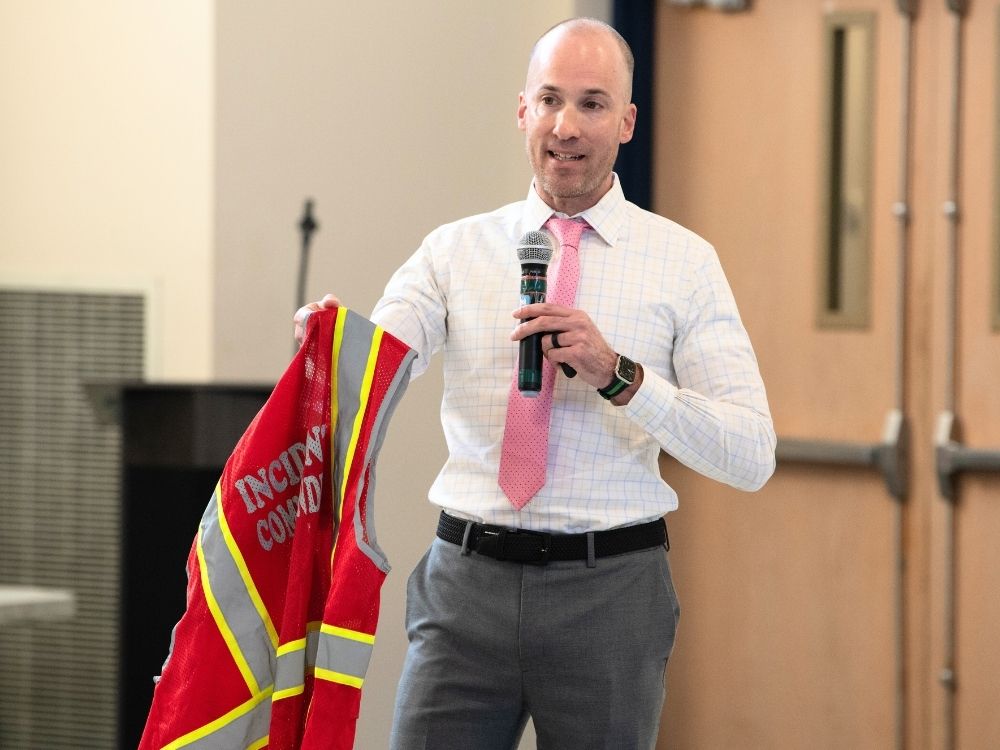
Eric Oddo, CHHS continuity program director, conducts a tabletop exercise for the Housing Authority of Baltimore City.
Where would executive leadership relocate? How would they communicate with residents across the city? What about the families whose apartments were damaged at Latrobe Homes?
Fortunately, it wasn't real.
The simulated EF2 tornado was the final test of a renewed partnership to strengthen HABC's emergency preparedness – a collaboration that began in 2018 when the University of Maryland Center for Cyber, Health and Hazard Strategies (CHHS) partnered with the agency to develop an Emergency Preparedness and Response Plan. In 2024, HABC brought the Center back to update that plan with lessons learned from COVID-19. The result was a sweeping effort to improve the agency's preparedness from the ground up.
"This work that we did with the Housing Authority is a great example of the kind of work that is representative of our mission at CHHS," said Markus Rauschecker, JD, executive director at the Center. "Helping prepare organizations, communities and jurisdictions for any kind of disaster that might come their way."
The 2024 partnership, which concluded with the Dec. 3 tornado exercise, focused on updating the Emergency Preparedness and Response Plan and creating a new Continuity of Operations Plan. CHHS also facilitated three tabletop exercises, each designed to test different aspects of HABC's emergency readiness.
Eric Oddo, MPA, continuity program director at CHHS, said tabletop exercises offer a valuable tool to emergency planners by allowing the chance to fail without consequences.
"A tabletop exercise is a conversational simulation of an emergency event," Oddo explained. "You get a group of people in a room together for a few hours. I present a plausible hypothetical scenario, and then we talk through what would be the operational, logistical, tactical and political steps they would take in response."
Each scenario strips away something essential, Oddo explained. "Do you take away their building? Do you take away their resources? Or do you take away their people?"
The first exercise revisited the July 2023 Brooklyn Day Shooting in Southwest Baltimore, giving HABC a chance to apply lessons learned from the real incident. About 50 staff members participated, working through improved response plans.
The second exercise, held in December 2024, addressed potential weaknesses in Baltimore City's IT disaster recovery program. Although HABC operates independently from the city, the agency wanted to ensure it was prepared. Oddo brought in about half a dozen IT vendors who support HABC systems to take part in a simulated cyberattack.
The final tornado scenario combined challenges from both previous exercises. It tested physical response capabilities when buildings are damaged while simultaneously addressing technology failures and business continuity.
About 60 participants took part in the Dec. 3 tornado simulation, including HABC's entire executive leadership team. Representatives from the Baltimore City Department of General Services and the Baltimore Mayor's Office of Emergency Management joined them.
Oddo presented the scenario in modules, starting with severe weather warnings at midnight and escalating to the tornado touchdown at 1 a.m. He showed authentic-looking National Weather Service graphics created by a colleague at the agency. He described wind speeds, structural damage and operational failures in detail.
The Charles L. Benton building at 417 E. Fayette St., home to HABC's executive leadership, was severely damaged. The roof was gone. The windows blown out. The fifth-floor server room was flooded, with equipment knocked over and soaking in water. Officials estimated the building would be unsafe for a month.
At Latrobe Homes, families needed to be relocated in the middle of the night.
Participants had to figure it out in real time.
Ingrid Antonio, senior vice president of communications at HABC, said the process helped transform how the agency thinks about emergency response.
"Eric and the team worked closely with our team and created an environment that allowed us to meaningfully engage not only within our agency, but also alongside our partners through a series of simulated scenarios," Antonio said. "Having the space to pause and think through our response rather than reacting in real time encouraged a more thoughtful and deliberate approach to decision-making."
The exercises clarified who makes which decisions, how departments coordinate and when to activate emergency protocols. They also revealed gaps that could be addressed before a real crisis hits.
"That process helped clarify roles, strengthen coordination and ultimately set us on the right track for how we should respond during real-world incidents," Antonio said. "From a communications perspective, it reinforced the value of preparedness, alignment and intentional messaging when managing emergency situations."
Rauschecker said the tabletop exercise format allows organizations to identify weaknesses without the pressure of an actual emergency.
"What we do at CHHS is help organizations plan for whatever might come and to help them respond and to and practice those potential incidents," he said. "A lot of good information comes out in terms of an organization's ability to respond and their level of preparedness."
CHHS has worked with numerous Maryland agencies and local governments, including Anne Arundel County, the University of Maryland Medical Center, the city of Rockville, the Maryland School for the Deaf, the Maryland Department of Transportation State Highway Administration and the Washington Suburban Sanitary Commission.
"We see ourselves as a Maryland institution here to serve Maryland jurisdictions and organizations," Rauschecker said. "We really take pride in being part of the University of Maryland and in creating these plans because we make Maryland better for it."