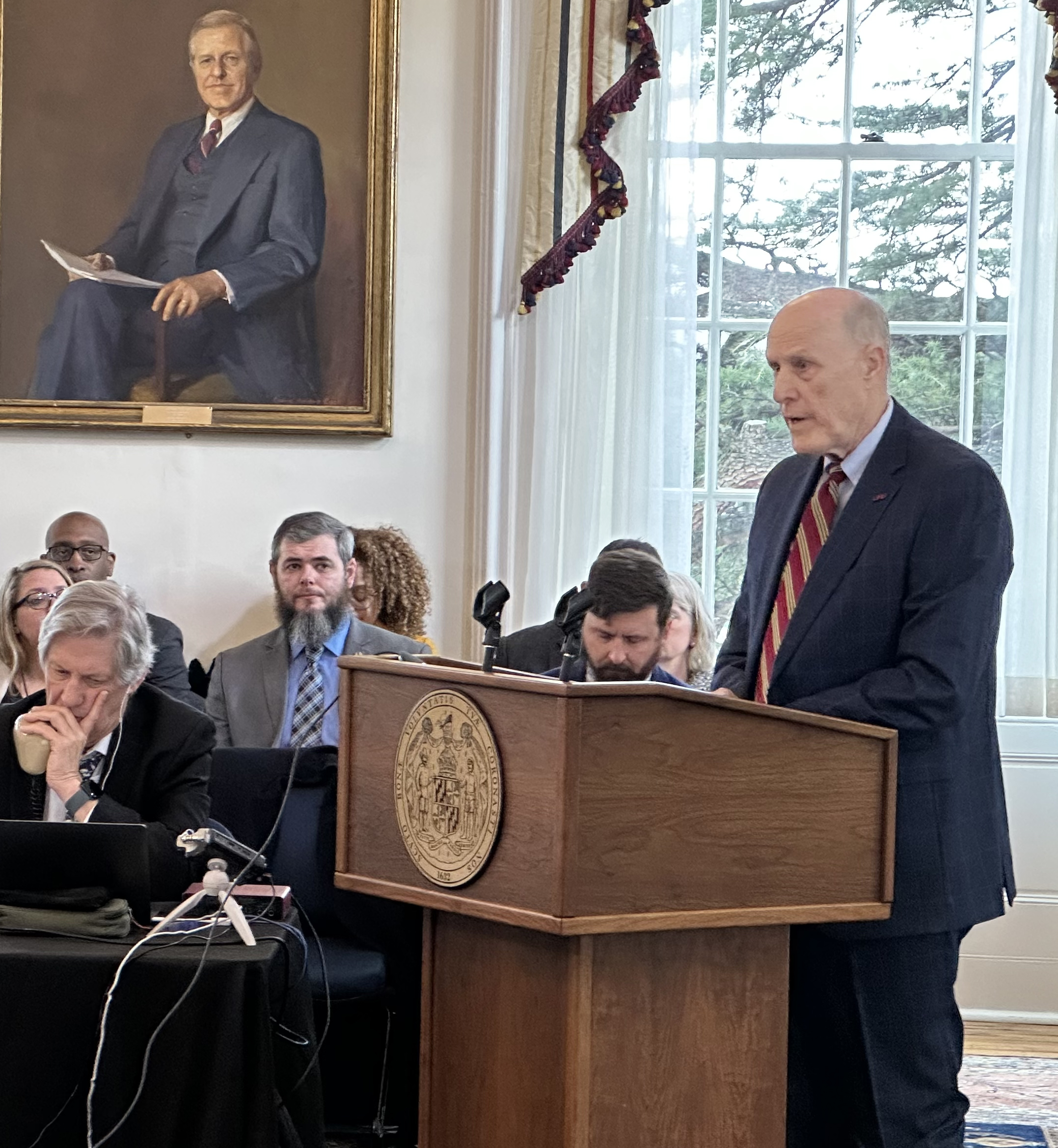


“My name is Stacy Jewell, and I am a survivor of human trafficking.” Now a nationally recognized survivor leader and award-winning playwright, Jewell came to the Maryland Statehouse in Annapolis on Feb. 3 to add her voice to a wide array of lawmakers and leaders from state and local government and social service and faith organizations all committed to the fight against human trafficking.
Headlined by Lt. Gov. Aruna Miller, the event was spearheaded by longtime survivor advocate Maryland Secretary of State Susan Lee, JD, and Susan Esserman, JD, founder and CEO of the University of Maryland Support, Advocacy, Freedom, and Empowerment (SAFE) Center.
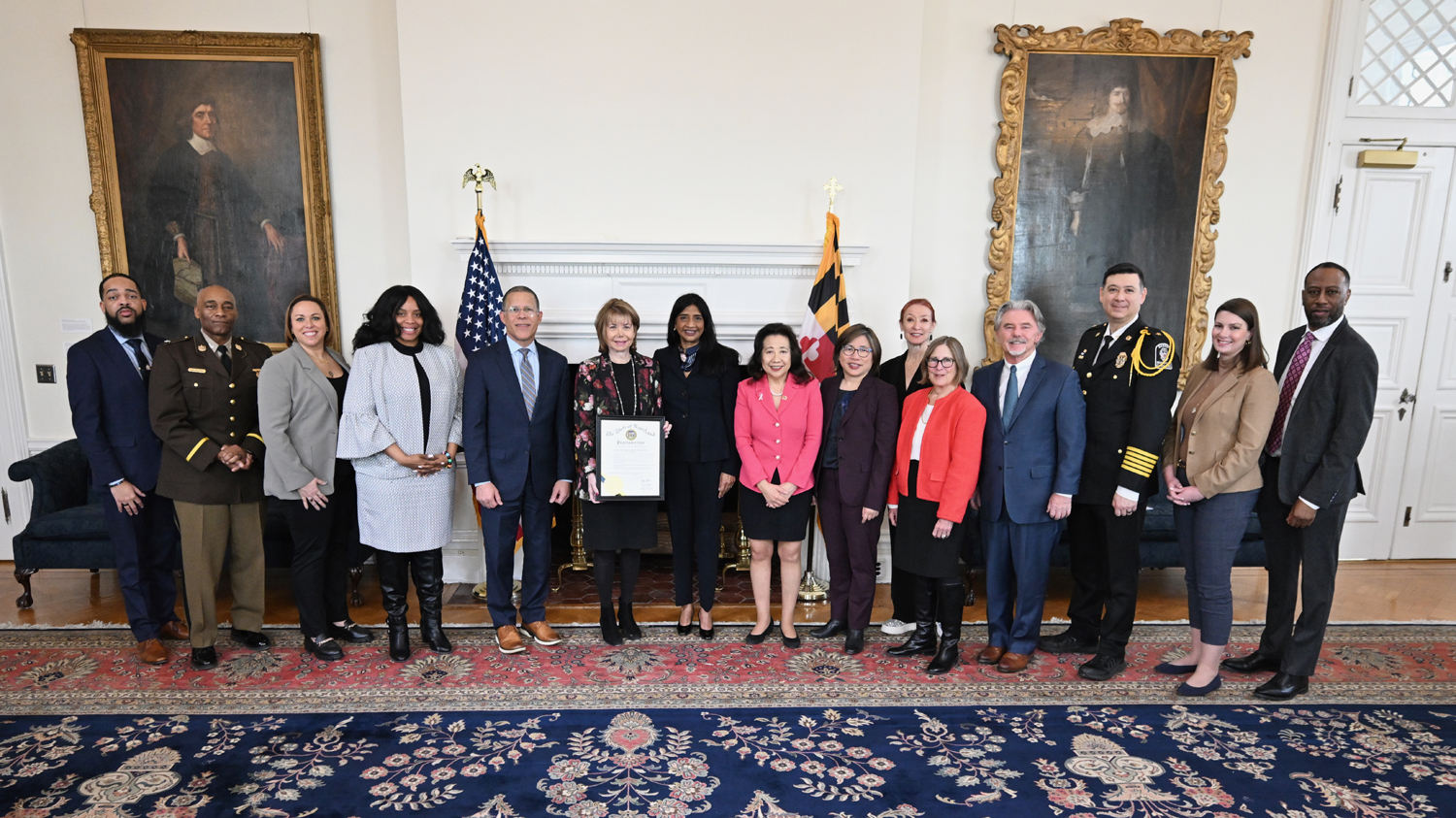
UM SAFE Center CEO Susan Esserman holds a proclamation, flanked on her left by Lt. Gov. Aruna Miller, Secretary of State Susan Lee, and Secretary of Labor Portia Wu, and on her right by Attorney General Anthony Brown and trafficking survivor Stacy Jewell.
Lee represented a district in Montgomery County in the Maryland House and Senate for more than two decades. During that time, she led efforts in the Senate to pass multiple important anti-trafficking legislative measures to protect youth vulnerable to trafficking, criminalize labor trafficking, and expand Maryland’s vacatur laws.
Delayed by unusually heavy snowfall throughout the region, the event was organized to hail January as National Human Trafficking Prevention Month but was clearly much more, a reaffirmation of commitment. Esserman expressed appreciation to Miller and Lee for highlighting “the crucial importance of the state of Maryland stepping up in the fight against human trafficking at this challenging time.”
“Twenty-five years ago, on Central Avenue in P.G. County, across the street from the Home Depot, there’s a Motel 6,” Jewell recounted. “I was a teenage girl who was kidnapped, abducted in Washington, D.C., and taken to that Motel 6. In that Motel 6, I saw 12-year-old girls, 13-year-old girls, and 14-year-old girls that were all there for the very same thing, to be bought and sold.”
“Maryland’s position along the I-95 corridor makes us especially vulnerable and places our communities directly in the path of trafficking networks,” Miller said. “Between 2013 and 2024, more than 1,300 child sex-trafficking cases were reported in the state of Maryland.” In 2023, the Gov. Wes Moore administration successfully pushed passage of the Safe Harbor Act, protecting child victims of sex trafficking from prosecution for prostitution and other non-violent crimes.
Miller pointed out, however, that another form of trafficking, labor trafficking, is on the rise, particularly among immigrants and domestic workers.
“We strengthened our laws so that labor trafficking of children is explicitly recognized as abuse, closing loopholes that once stood in the way of justice,” Miller said.
Maryland Attorney General Anthony Brown, JD, who served in Congress and as lieutenant governor of Maryland, echoed the criticism issued by anti-trafficking advocates across the country who have decried the withholding of funding and support for survivors, as well as the loss of experienced federal workers who were engaged in the fight against trafficking.
“When the federal government abandons its responsibilities, Maryland doesn't abandon ours,” he said. “Our Federal Accountability Unit has preserved millions in federal funding for victim services and defended access to critical resources. Our criminal division works tirelessly to vindicate victims’ rights and bring perpetrators to justice.”
“Under these circumstances, it is especially important that Maryland maintain funding levels for crime victim services. We appreciate that the governor has recognized this priority in his budget, and we urge the legislature to preserve that priority,” Esserman said.
The SAFE Center, an initiative of the University of Maryland Strategic Partnership: MPowering the State, provides comprehensive, trauma-informed services to empower survivors of sex and labor trafficking to heal and reclaim their lives.
Esserman expressed thanks for the work of the attorney general’s office for its role in investigating labor trafficking cases. She encouraged that additional steps be taken to remove barriers to victims of labor exploitation pressing claims. She also expressed support for establishing a worker protection unit in the Office of the Attorney General and future consideration of strengthening wage theft and anti-retaliation laws.
“Today, a majority of our cases at the SAFE Center involve labor trafficking, a form of extreme human exploitation where perpetrators compel victims to work against their will in appalling circumstances, in domestic work, in agriculture, in construction, and many other sectors,” she said. “While many people believe that labor trafficking does not take place in Maryland, our statewide survey showed that in a recent five-year period, Maryland service providers assisted nearly 1,200 labor trafficking survivors.”
“Labor trafficking is a direct assault on the safety of workers in our state, on people’s right to dignity and fairness in their workplace,” agreed Maryland Secretary of Labor Portia Wu, JD, MA. “The enforcement of labor standards is not just a regulatory duty, but it's a moral imperative to protect workers everywhere from exploitation and harm.”
Wu also explained that her department oversees compliance with Maryland’s Innkeepers’ Laws, ensuring that hospitality workers are trained and able to detect and identify potential worker exploitation.
“When our investigators flag potential labor trafficking concerns doing routine wage audits, we ensure those leads reach experts, including the SAFE Center, the attorney general, and others who can provide survivors with the critical legal and social services they need,” she said. “We are dedicated to ensuring that every workplace in this state is a place of safety and security, not a site of subjugation.”
The Maryland Department of Human Services also is fully engaged. As of 2024, Maryland recognizes labor trafficking as child abuse, explained Alger Studstill, DBA, MBA, who leads the department’s Social Services Administration.
“Within the past year, over 500 staff and supervisors have been trained to identify and respond to labor trafficking through a trauma-informed lens, and it's our intent to continue that training effort,” he said. “Our team is working to prepare to present at the 2026 PREPARE School Safety Conference and is currently expanding partnerships with the Board of Education as well as hospital emergency departments for earlier intervention.”
Amanda Rodriguez, JD, chief executive officer of TurnAround, Inc., a rape crisis center and domestic violence and human trafficking service provider, recounted a conversation with a teenage sex-trafficking survivor.
“So, if you could tell the public anything you think we do not fully appreciate about human trafficking, what would that be?” she recalled asking the survivor. “She answered quietly and without hesitation: ‘No one seems to understand how scared we are.’ That sentence has never left me.”
“We have to start by believing,” added Lisae Jordan, JD, executive director of the Maryland Coalition Against Sexual Assault. “We have to start by listening. We have to continue to listen.”
Jessica Emerson, JD, MSW, director of the Human Trafficking Prevention Project at the University of Baltimore School of Law, emphasized that criminal record relief should be considered human trafficking prevention, as well as for its positive impact on survivors’ healing processes by expanding access to safe housing and employment prospects. She urged expanding the crimes eligible for vacatur.
Nearly a dozen other service organizations were represented in the Governor’s Reception Room, including Survivor City, the University of Maryland, Baltimore Center for Violence Prevention, Araminta, Centro de los Derechos del Migrante, Heartly House, International Rescue Committee, Prince George’s County Family Justice Center, and Restorative Response Baltimore.
Michael Jackson, MS, acting superintendent of the Maryland State Police, emphasized the challenge in fighting human trafficking. “We can thwart the crime at the time, but without you all, the service providers, we can never make survivors whole. So, we need you," he said.
Rev. Tony Lee concluded the event by reaffirming that “even when the federal government says no, we have to say yes to the humanity of every person.”
You Might Also Like
 Local and National Impact
New Approach Allows Address-Level Assessments of Marylanders’ Proximity to Health Care and Hazards
July 14, 2026