

Lexington Street Transformation
The University System of Maryland Board of Regents gave the green light Feb. 13 to a plan that will transform the sparsely used north end of the University of Maryland, Baltimore (UMB) campus into a bustling “Collegetown,” with housing, retail, and even outdoor entertainment and recreation space. The West Lexington Corridor project, as it’s called, is a significant part of UMB’s overall Vibrancy Initiative, something University leadership has been bringing into focus over the last two years.
“We think it benefits the university. It benefits the students that come here. It benefits the faculty, staff, and as importantly, it benefits the city,” explained UMB Provost and Executive Vice President Roger J. Ward, EdD, JD, MSL, MPA, at a UMB Staff Senate meeting last February. “And we think that with some of the experiences that we've had with the BioPark and some of the assets that we have, we could, together with the city and other developers, take the lead in creating what Baltimore so badly is missing.”
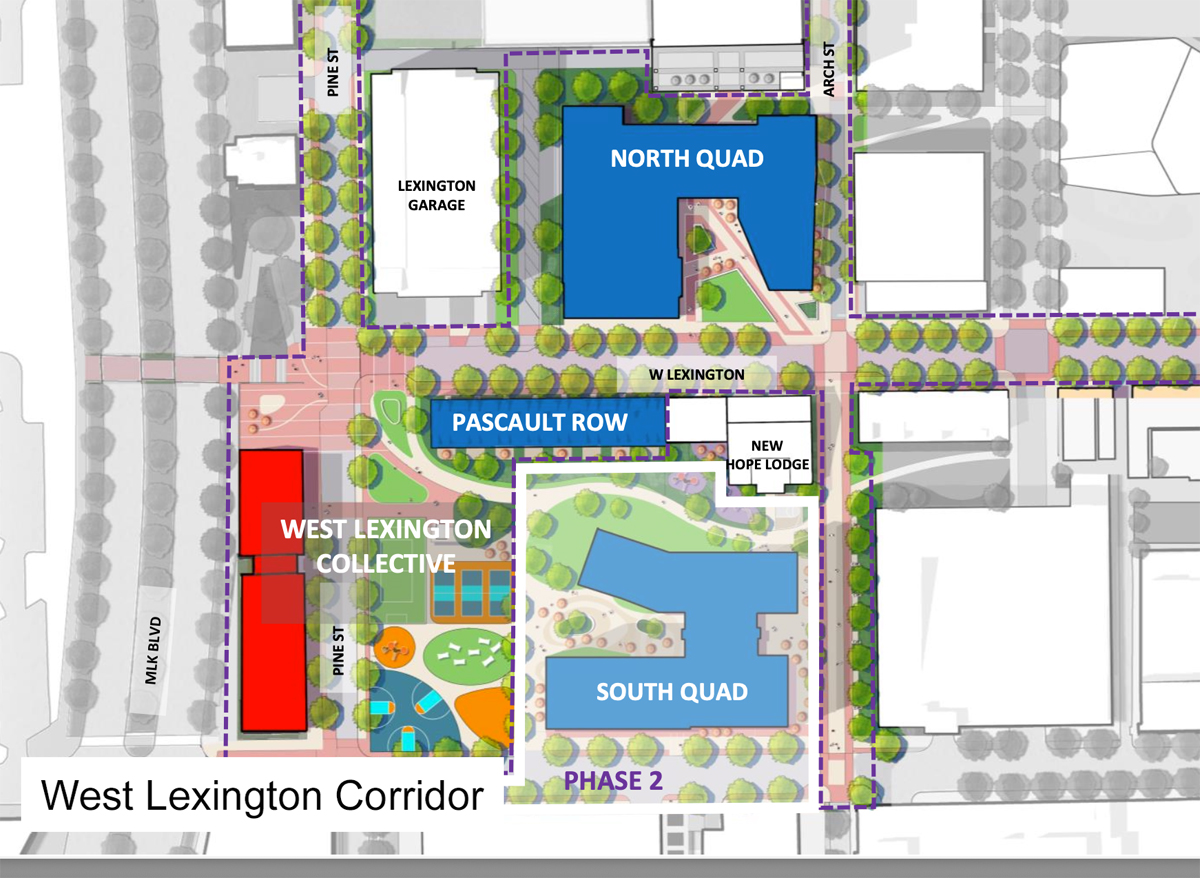
Map of the proposed West Lexington Corridor project
“Where can you live where you've got a Broadway theater?” UMB President Bruce E. Jarrell, MD, FACS, added. “You've got a Major League Baseball, a major football team. You're going to have a rejuvenated inner harbor and a vibrant downtown.”
The ultimate goal, summed up clearly by Chief Enterprise and Economic Development Officer and Senior Vice President James L. Hughes, MBA, the architect of so many new developments on and close by campus, is to “create the type of environment that everybody says, ‘Wow, that's a great university. I want to go to school there. I want to work there. And it's one of the best places in Baltimore, and really the region to live.’”
The West Lexington Corridor project will redevelop key parcels along the 600 block of West Lexington Street, just west of Greene Street, between Pearl and Pine Streets. By transitioning land-banked parcels into productive development sites, UMB is helping return long-underutilized property to the City’s tax rolls, creating a powerful win for the University, the City, local businesses, and the surrounding community.
“This project is a once-in-a-generation opportunity to transform a critical avenue of our campus and strengthen our connection to the neighborhood,” said Jarrell. “We are excited to take this next step toward creating a more vibrant, inclusive, and welcoming district that supports our students, faculty, staff, and the broader Baltimore community.”
What’s in the Plan?
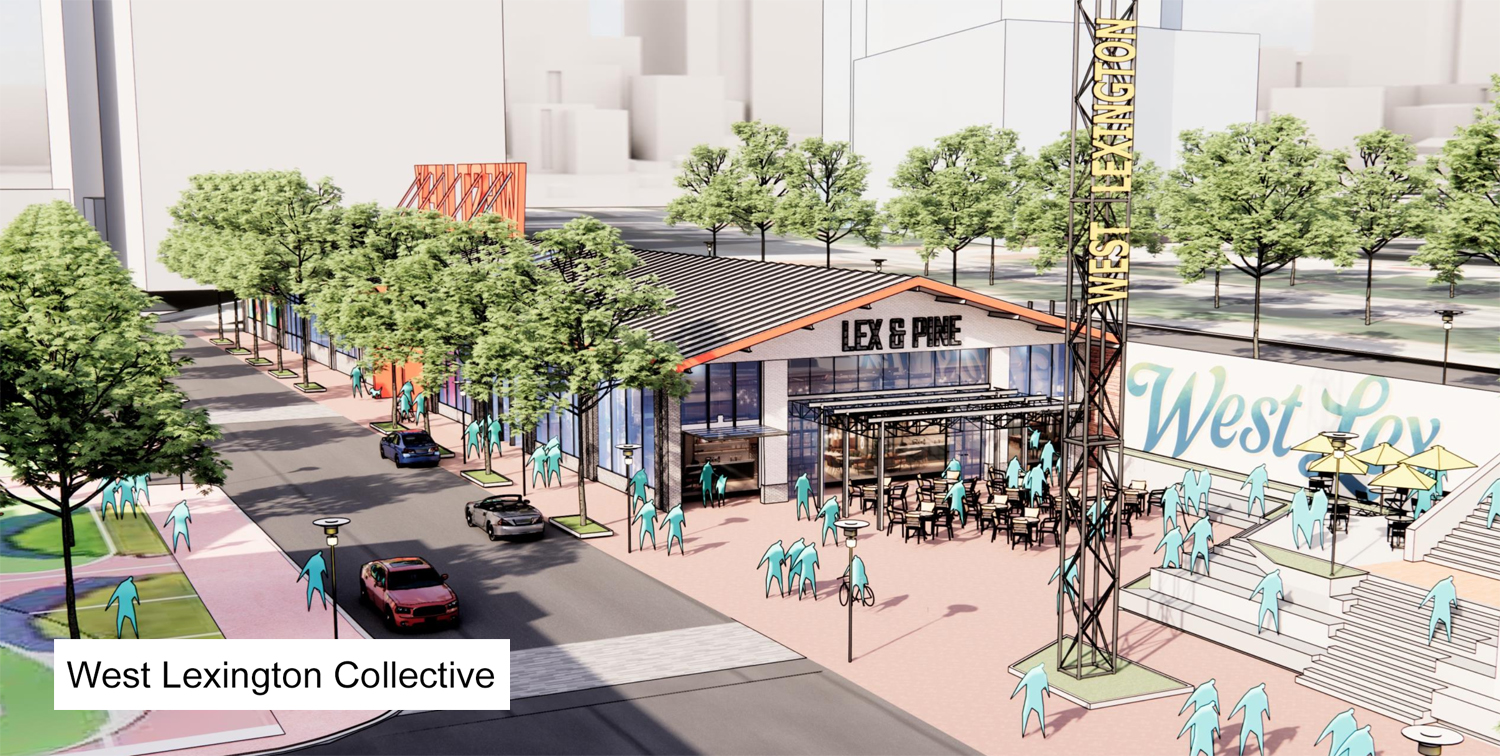
Work on the first phase of the plan, scheduled to begin in early 2027, will include a 15 floor North Quad tower with 356 apartments (764 bedrooms) and 15,800 square feet of ground floor retail. The existing Pascault Row residences will be renovated to become a multi-family building, and the Pharmacy Learning Center on Pine Street will be renovated into a 16,500 square foot indoor gathering and recreational center called the West Lexington Collective.
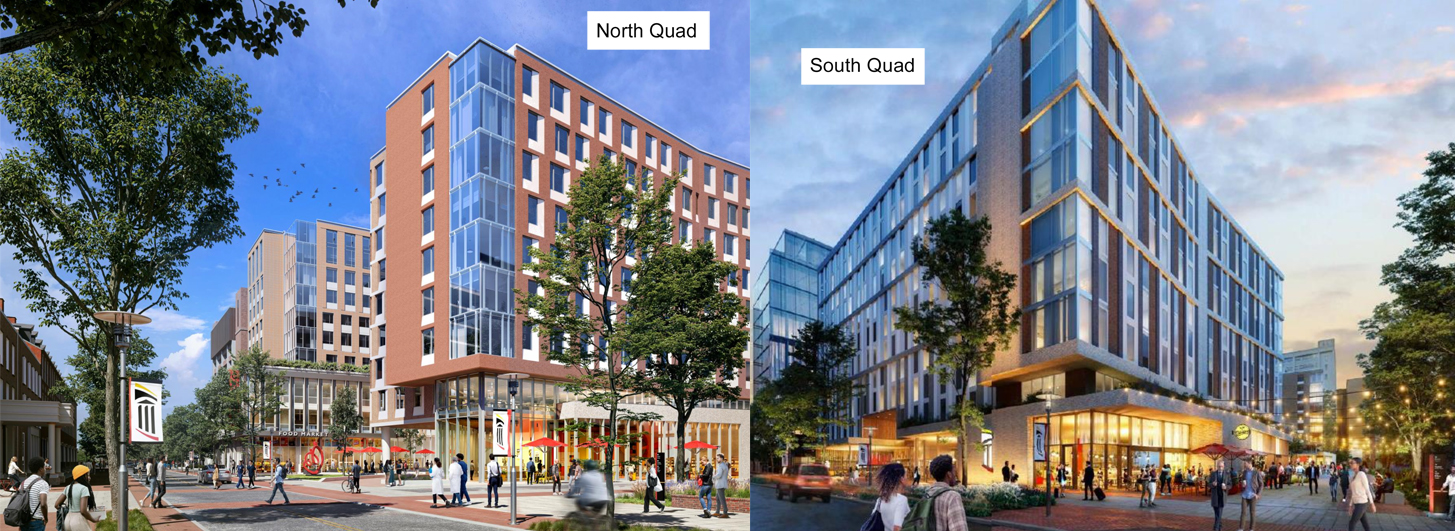
One year later work will begin on a second phase, including a South Quad building with 380 bedrooms and more than 9,000 square feet of additional ground floor retail. The second phase of the plan will also see extensive sidewalk and streetscape work, as well as the installation of public realm placemaking improvements.
The West Lexington Corridor project continues the redevelopment momentum of the West Side of Baltimore’s Downtown created by two other exciting projects. UMB is building a new $120-million, 127,000 square foot home for the University of Maryland School of Social Work at West Lexington and Greene Streets which is expected to open in late 2027. And the State of Maryland will move the headquarters of the Department of Health to the former site of the Social Security Administration at Metro West. That 1.1 million square foot facility is located just one block north of the West Lexington Corridor project on Saratoga Street. Renovation there is set to wrap up at the end of this year.
Collaboration with Wexford Science and Technology
One of UMB’s closest partners on key projects was also chosen through a competitive process to develop the West Lexington Corridor. Wexford Science and Technology, which built and operates the BioPark’s newest facility, 4MLK, will invest $263 million to bring the project to life under 99-year ground leases. The University will contribute $36 million, about a third from the proceeds of the ground leases, and the rest from the UMB Foundation, a Maryland Department of Housing and Community Development grant, and the value of work to be performed by UMB related to the Pharmacy Learning Center renovations and the new outdoor recreation space.
UMB will also invest about $300,000 annually to support programming to help activate the corridor.
UMB and Wexford held pre-development discussions with the Baltimore City Department of Planning in November 2025, with additional City approvals anticipated in 2026. Pending approval from the Maryland Board of Public Works and subsequent Baltimore City reviews, the project is expected to begin Phase 1 construction in 2027, with initial openings projected for 2029.
“The West Lexington Corridor project is central to UMB’s broader Vibrancy Initiative, which focuses on placemaking, connectivity, and enhancing the campus experience,” said Hughes. “We look forward to continued collaboration with our partners at the City, State, University of Maryland Medical System, and local stakeholders to bring this vision to life.”
Wexford will partner with GMH Communities (GMH), and Graffito SP to deliver the project. GMH is a vertically integrated real estate company and brings more than 40 years of student living experience and a deep expertise in developing residential communities in urban university districts. Graffito SP focuses on retail and first floor activation in mixed-use projects and has extensive experience working with and around urban universities. Wexford, GMH, and Graffito have successfully partnered on transformational university related projects nationally with stakeholders including University of Pennsylvania, Drexel University, Brown University, and the University of California, Davis.
Plan Details
- Housing will include a 15-story North Quad with 764-beds and South Quad with 517-beds. All housing will be open to the general public
- Up to 25,000 square feet of ground floor commercial retail space will be leased by UMB and offered for sublease.
- An outdoor recreation will be included in the development.
- The existing Pascault Row housing facility will be renovated to become family housing, and the Pharmacy Learning Center will be renovated to become an activity and social space.