

UMSSW Program Helps Baltimore Girls ‘Bloom’
Positive vibes radiated in Baltimore Unity Hall with the bass cranked to 10, where for one afternoon 200 middle and high school girls gathered to support one another and, more importantly, themselves.
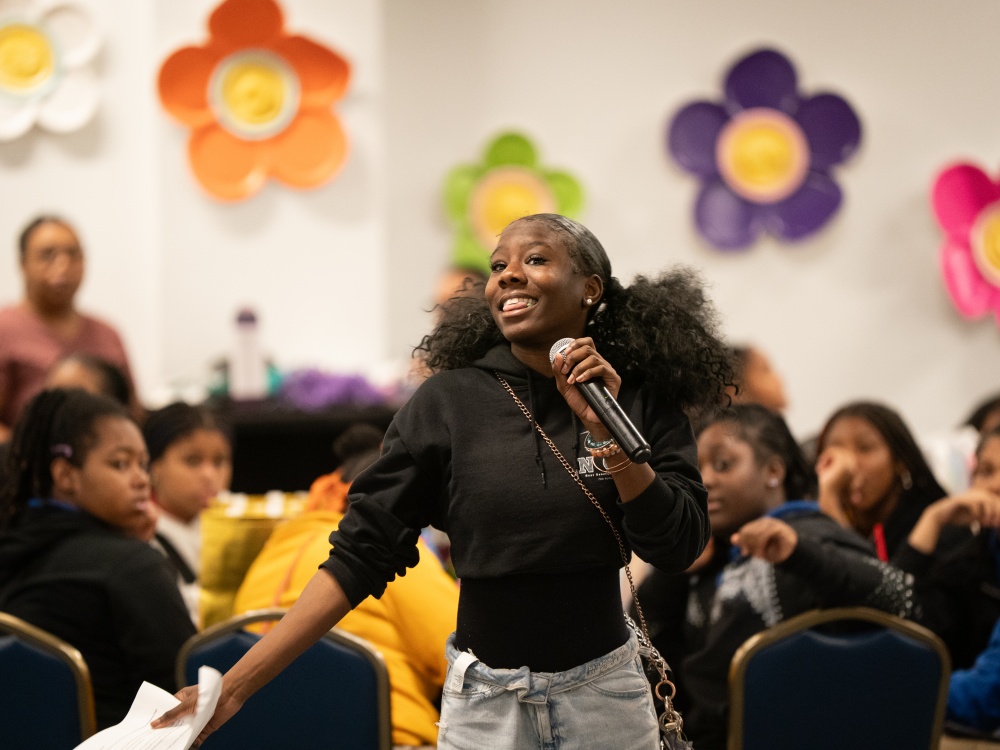
Renaissance Academy 11th-grade student Charde Falcon speaks about revolutionary joy at Bloom.
Students danced and sang together — even teachers got in on the act — and snapped selfies in a room decorated with bright colors to celebrate their full selves during a time in their lives when these teens face questions about their identity.
“This is Bloom: Beautifully Living Out Our Me” — an event in its second year led by the University of Maryland School of Social Work’s (UMSSW) Positive Schools Center (PSC) — is designed to give power to themselves. More than 20 schools from Baltimore City Public Schools (BCPS) were represented.
PSC, which is celebrating its 10-year anniversary in 2026, crafted this program to celebrate women’s empowerment for the teenage girls to give them the confidence to be themselves, said the center’s executive director, Shantay McKinily, MS.
“Our work is all about creating a positive culture for schools throughout Baltimore City, so it’s about creating restorative environments and being able to advocate for yourself,” McKinily said. “This event aligns with that mission because it shows to these girls that, ‘I’m amazing, and I do have a voice and I’m able to express myself.’ ”
And in school, that can be a tall order, where in BCPS, Black girls have been suspended or punished more than their peers, which was the subject of a 2018 report authored by the Thurgood Marshall Institute of the Legal Defense Fund of the NAACP.
As the event title suggests, the activities are designed to encourage girls to “bloom into themselves,” McKinily said.
During one activity, girls would approach a mirror in the room with a prompt above it, like “Complete this sentence: My voice matters because …” These mirrors help tell these young women that they are valued, said Wendy Shaia, EdD, MSW, clinical professor and director of the UMSSW Center for Restorative Change.
“So many of society’s messages tell these young women that they’re not beautiful, they’re not smart, they’re not valuable,” Shaia said. “And they come here, and there are mirrors all over the place with messages to remind them of their beauty, and their brilliance, and their power. No matter what the world tells them, all these women are here to support this community of young women.”
During a group activity, girls were asked to define this year’s theme, which was: “What does revolutionary joy mean to me?”
“I think revolutionary joy means to uplift others and to be different and be your true self,” said Lyric Slaughter, an eighth-grader at Barclay Elementary/Middle School.
As Charde Falcon, an 11th-grader at Renaissance Academy, led the revolutionary joy activity, she confided in the girls how tough it is after losing her grandmother while also dealing with friend issues and “boy drama.” She said she had to remind herself that “joy isn’t something that just happens.”
“Joy is something you choose, even when everything feels like it’s going wrong,” Charde said.
Taylor Fraling, an 11th-grade student at Western High School, said her favorite part of the event was being in a “room full of young, bright women.”
“What makes it special for me is we get to realize when we’re in this space, we don’t always have this space to be together, especially when you’re talking about young women in minority communities,” Taylor said. “We’re never uplifted. We never had the chance to be uplifted or uplift each other.”
Bloom is just one of many programs like it that PSC has offered during its 10 years to help improve behavioral outcomes and mental health in Baltimore schools.
Tracey Durant, EdD, MS, senior executive director of the BCPS Office of Equity, can attest to those changes, resulting in a cultural shift in BCPS schools. Durant also serves as a PSC Advisory Board member.
“A lot of the culture climate, a lot of wellness work is really reactive, and what this event allows us to do is to be proactive,” Durant said. “It allows us to bring young people together and talk to them about how you have healthy relationships.”