

UMSOD-Kennedy Krieger Dental Partnership Fills Gap for Kids with Special Needs
The University of Maryland School of Dentistry (UMSOD), has partnered with the Kennedy Krieger Institute to provide dental care for children and adolescents with neurodevelopmental disabilities, the first such program at Kennedy Krieger in over 20 years.
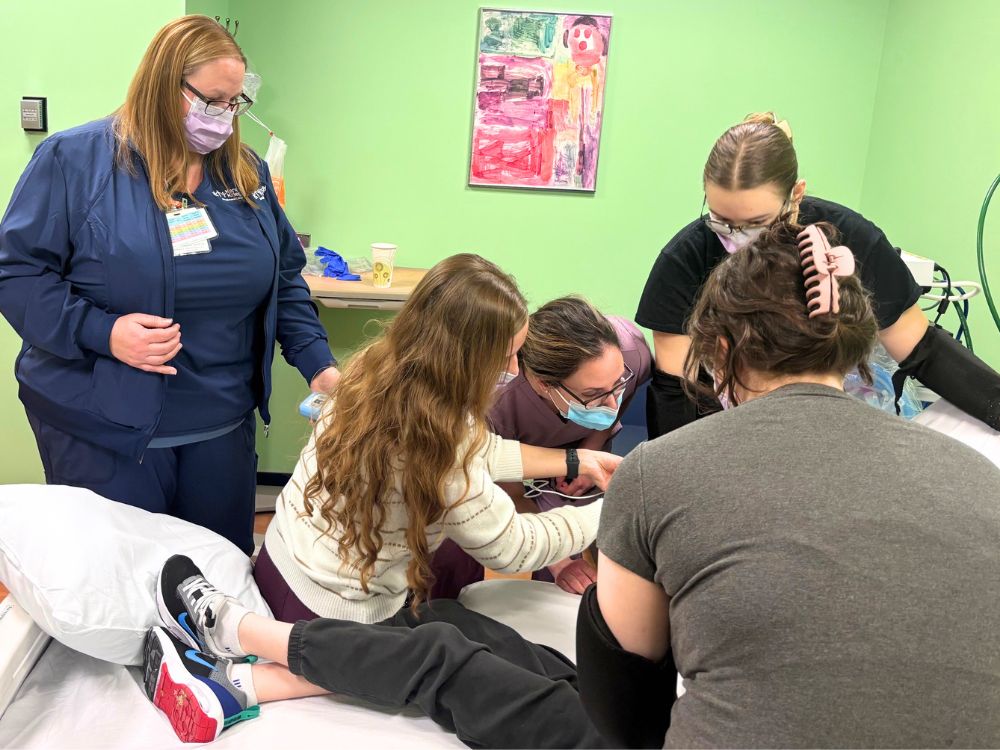
UMSOD’s Erica Caffrey (center) performs a dental exam on a patient at Kennedy Krieger.
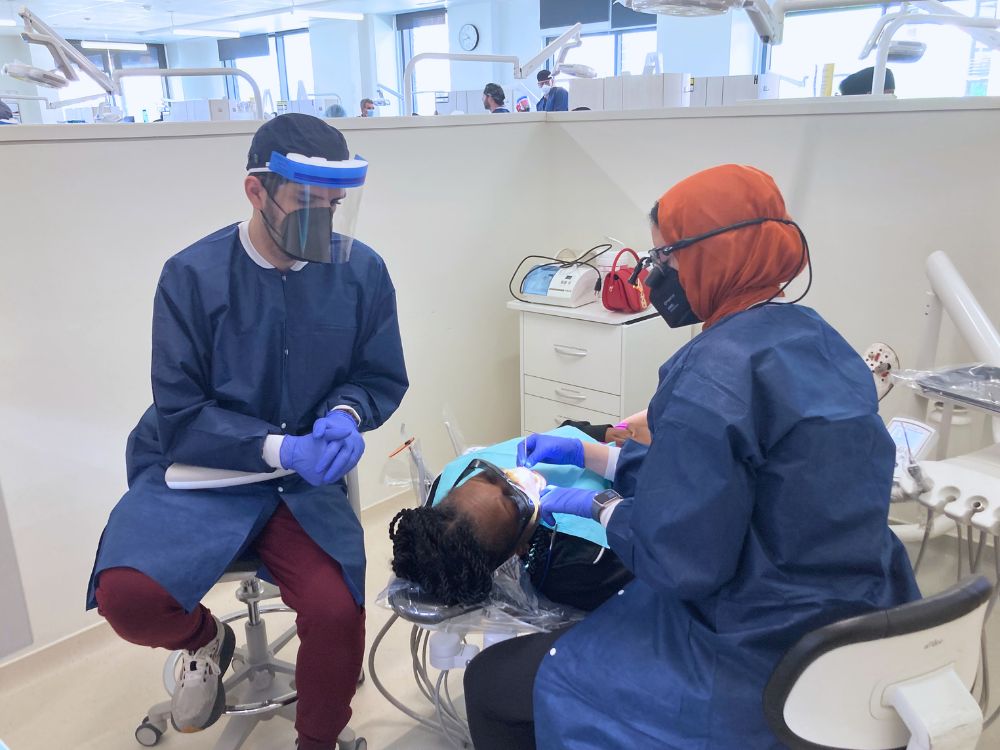
Since September, Erica Caffrey, DDS, clinical assistant professor of pediatric dentistry, has traveled to Kennedy Krieger accompanied by a UMSOD pediatric dental resident to conduct monthly oral health exams for children in the Baltimore-based institute’s Neurobehavioral Unit. According to Caffrey, the visits address a persistent gap in dental care for children with neurodevelopmental disabilities.
For children with severe autism, intellectual developmental disabilities, and complex genetic syndromes, a trip to the dentist can be an ordeal that most dental offices are not equipped to handle. Sensory sensitivities mean that everything from the overhead light, to the taste of a latex glove, to the color of a lead apron, can trigger distress. Some patients exhibit combative or self-injuring behaviors and wear helmets or protective clothing. Many can’t communicate verbally.
Often, the solution is to refer the child for dental work under general anesthesia. That means added medical risk and a waitlist that can stretch for months.
“Often, when these kids can’t get dental exams, they get referred immediately for dental exams under sedation or general anesthesia, which increases health care burden, cost of care, and medical risks,” Caffrey said. “If an exam can be accomplished without that, then we may avoid those increased burdens and risks.”
Impactful Results
The program’s approach is based on interdisciplinary collaboration among pediatric dentistry, pediatric medicine, and behavioral psychology. Before each dental visit, a Kennedy Krieger behavioral psychologist works with the child over several sessions to desensitize them to the exam environment. Patients practice sitting in the chair and are slowly introduced to dental instruments, the feel of gloved hands near their face, and opening their mouth long enough for an exam. They can be seen in a hospital bed or in a more traditional dental setting depending on the needs of the child.
Caffrey said the results have been striking.
“I’m seeing really remarkable outcomes where a patient who previously couldn’t sit down in a chair comes in and is willing to allow a dental exam, have fluoride varnish applied, and, in some cases, even put on a nasal mask to breathe some laughing gas,” she said. “That requires a lot of work on the part of the behavioral team. But it shows that there is hope and promise for these kids, and that patience and practice can really help.”
In the roughly 20 exams conducted since September, only one of the patients has required follow-up treatment for decay, Caffrey said. That patient was able to be seen for an additional visit in the same clinic for caries management. Many have tolerated X-rays, an outcome Caffrey said was remarkable given the severity of their behavioral challenges. According to Kennedy Krieger staff, several parents have cried happy tears upon learning their child was finally going to receive a dental exam.
Bring the Dentist to the Patient
The partnership grew out of conversations that began about two years ago when Kennedy Krieger’s leadership reached out to UMSOD’s Department of Orthodontics and Pediatric Dentistry. Caffrey and Vineet Dhar, BDS, MDS, PhD, clinical professor and chair of the department, toured the institute and met with department leaders to discuss how oral health fits into the broader care of children with special health care needs.
Caffrey began giving presentations to health care providers and interdisciplinary student teams at the institute. Then a specific request came in from the Neurobehavioral Unit, an inpatient program in which children and young adults with severe behavioral and developmental challenges are admitted for months at a time for intensive therapy.
Staff had tried referring some patients to UMSOD, but transporting inpatients with complex behavioral needs was difficult. And although the dental school’s pediatric clinic treats many children with neurodevelopmental disabilities, additional staff support needs can make it challenging to safely examine individuals with severe behavior.
“It became a question of: ‘Where is the best setting and who from the team is needed to accomplish the goal of providing preventive oral health services?’ ” Caffrey said.
The answer was to bring the dentist to the patients.
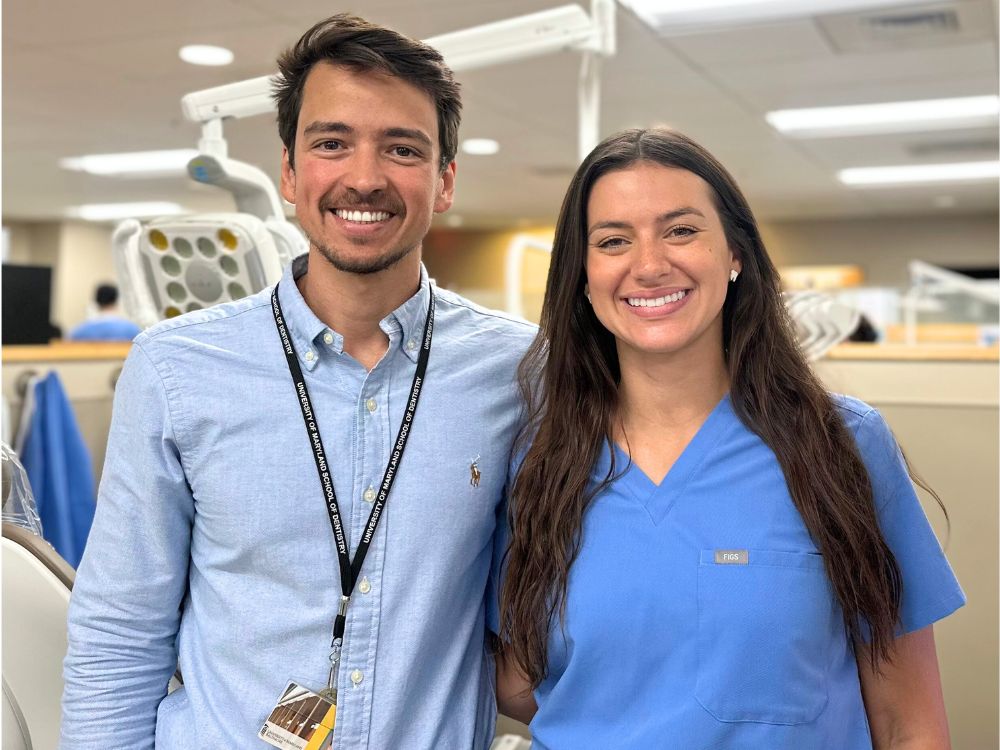
The program runs on the second Thursday of every month under a formal contract between the two institutions. Each month, Caffrey brings a different pediatric dentistry resident to Kennedy Krieger as part of a special health care needs rotation. The residents participate in exams and observe the behavioral preparation process, feeding therapy, and speech therapy. Caffrey, who also serves as assistant director of the residency program, said the experience is reshaping how trainees approach their work.
Gabrielle Le, DDS ’19, a UMSOD graduate in her second year of pediatric residency, said she will take what she’s learned through her rotation at Kennedy Krieger into the next stage of her career.
“There are a lot of kids with special health care needs, and even patients that don’t have special health care needs but maybe require a little bit more behavior management or patience,” she said. “I will definitely take this into private practice so that I’m comfortable with treating patients of all medical and social backgrounds.”
Le said part of the success of treating patients at Kennedy Krieger is meeting them where they feel at ease.
“It’s great because we get to go where the patients are most comfortable. It takes out that component of a whole new environment and we’re able to do a bit more and provide a needed service for the patients.”
Caffrey agreed that the environment is a key factor to a successful appointment.
“Traditionally as dentists, we think about completion of a procedure and documenting procedure codes,” she said. “But in the context of a child’s overall health care, we have to think much more about the patient experience.”
Building a Model Program
Caffrey plans to use what she learns at Kennedy Krieger to develop formal desensitization and preparation protocols at UMSOD for all children with neurodevelopmental disabilities.
“At the School of Dentistry, we really strive to serve kids who have struggled to get care elsewhere and to serve high-needs groups,” she said. “I would say not a week goes by where I don’t hear from, usually, mothers who are struggling to find their kids dental care — whether it’s due to their medical history, their developmental history, or just financial. Caring for the underserved — that is our main mission.”
The program was initially scheduled to run through May, but it has been such a success the contract has been renewed to go until 2027. Caffrey said she sees the program as a potential model for other institutions.
“No individual should ever be written off for lack of capability to do something,” she said. “If we can create environments where these kids can get care in a more timely and thoughtful fashion, in a comprehensive way, maybe we can make access to dental care for these kids less challenging. Engaging with the medical team, children, and their families is critical to improving pediatric oral health.”