

|
|
UMB Students in Six Schools Team Up To Find New HIV Infections, Aim Patients to Care |
In a unique program at the JACQUES Initiative (JI) of the Institute of Human Virology (IHV) at theUniversity
of Maryland, Baltimore (UMB) called Preparing the Future (PTF) 334
students so far have gained invaluable communications skills in an
interprofessional approach to testing and counseling HIV patients,
according to Alexandria 'Allie' Reitz,
community program coordinator for the University's JACQUES Initiative.
The PTF is designed as a model for the nation and is
supported by a grant from Gilead Sciences' HIV FOCUS Program, for the
JACQUES Initiative (JI). By participating, UMB students "gain
invaluable communication skills through the PTF's interprofessional
approach," says Reitz.
A central component of PTF brings together teams of graduate students
from the University's dentistry, law, medicine, nursing, pharmacy, and
social work schools to identify new infections of HIV and increase
access to care for people living with HIV, aimed at addressing the
goals of National HIV/AIDS Strategy (NHAS).
Throughout the 2012-2013 academic year, interprofessional teams of
students and faculty advisors have been discussing and managing patient
cases at designated HIV testing sites, such as Community, A Walgreens
Pharmacy on Baltimore's busy downtown Howard Street.
(PTF team members pictured are, from right to left, social work student
Linda Kokenge, pharmacy student Rilwan Badamas, nursing student Yvonne
Gitukui, and medical student Rupal Jain.)
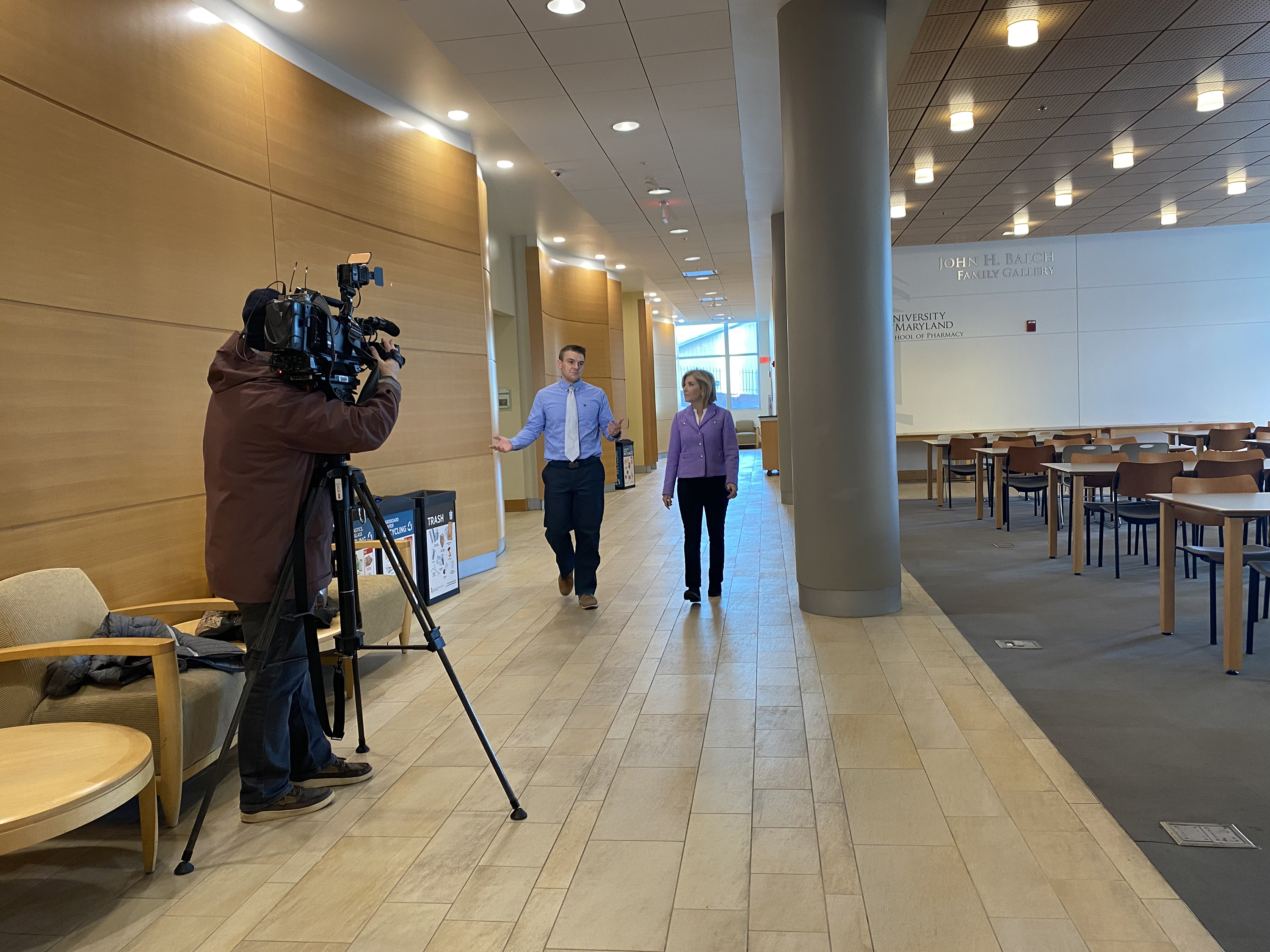
Recently at Walgreens, Reitz organized more than a dozen students to
rotate through several duty stations during a typical service-learning
day. First, she placed second-year pharmacy students Nchinda Ngeche and
Stephanie Yager outside, in front of the pharmacy wearing their
signature white pharmacist jackets. Equipped with leaflets, fliers, and
friendly smiles, the students applied their earlier training to query
passers-by if they might consider taking a free HIV test.
Yager says that after completing the PTF basic HIV101 course, she was
inspired to work with the patients. "Now I think I want to do disease
management, a new role for pharmacists." Ngeche also was hooked, "When
you are a pharmacist, you will need [the PTF] experience. It shows me
another part of health care, learning how to address different
patients."
Inside, Reitz assigned other students to small private rooms for
patient testing, an oral swab that takes 20 minutes to yield results.
Yager admits that she was nervous before testing her first patient, but
"it was not as scary as I thought it would be. I feel good about the
experience."
Reitz assigned other students, starting with first-year students Jon
Watson, and Maggie Connally, with the UM School of Medicine, to
checking in patients and helping them with necessary paperwork. Watson
says he was delighted for a chance to work with alongside pharmacy
students so early in his graduate school career.
Reitz assigned the remaining students to test, providing counseling and
results to each client. Brandon Fleming, another second-year pharmacy
student said he is eager to help his fellow Baltimoreans. "Yes, I am
interested in HIV as an infectious disease," he says, "but also, I am
concerned about the community. I am a native Baltimorean and passionate
about the health of the community."
Jeanette Robinson, a second-year student in clinical mental health in
the UM School of Social Work, agreed, "I wanted to help the community
of Baltimore build an awareness that there have been massive changes in
HIV [management] due to better, cheaper meds and lifestyle. Doing this
outreach testing, I feel good inside because every person I reach can
bring someone else." Robinson is also an epidemiology assistant with
the School of Medicine's Center for Mental Health Services Research.
Linda Kokenge, a first-year School of Social Work student, felt
comfortable performing community service at Walgreens, "I want to do
HIV case management after graduating, so this is great training."
Also on hand, were several non-student volunteers working alongside the
students, such as Kithia Gray. "I wear many hats here," she said. "I am
a client of the JACQUES Initiative [HIV clinic], an ambassador for the
clinic, an HIV tester, and an outreach volunteer." The enthusiastic Gray was diagnosed with HIV in 1997, she said, after contracting the
virus by sharing a needle for drugs. Her last "bout" with drugs was in
2009, landing her in the hospital where she was introduced to the
JACQUES Initiative. "Now, the virus is undetected, thanks to the clinic
at JACQUES."
Many of the students reported that working as a team helps them
identify with the particular state of mind of patients. For example,
second year pharmacy students Ellie Rahgozar and Mary Afrane
successfully tested one patient, but only after he had become unruly at
first. They shared their experience with Reitz at a debriefing session.
"This first patient was very hard because for me acting as a friend, I
do not want to sound like I am judging him," said Rahgozar.
One of Reitz tenets, she said, is to challenge the health care
professional students to stay open and friendly. Reitz said, "When we
sit down, we ask ourselves how do we avoid stereotypes. What kind of
open-ended questions do we ask to dispel the stereotypes? Then we need
to draw [a patient] out and dispel them." She adds, "I always urge the
students 'go deep.'"
The law students in PTF also counsel HIV patients in a special clinic
each Tuesday at the JACQUES Initiative, accompanied by preceptor
attorneys, on issues of insurance, benefits, financial support, and
more. Jeff Weaver, a JI physicians' assistant, said the legal issues
are "another critically important professional side of HIV health,"
says Weaver.
Third-year law student Blake Walsh said when she entered the program,
"I wondered what is the best way as lawyers to discuss this with
medical providers. How can we start that conversation?" She also said
that the law students' role is not just to score benefits for the
patients, "only if we are presented with that opportunity."
"It is real life," says Bill Rader, also a third-year law student. He
says that in managing HIV cases, there are medical, mental health, and
other models, "but it became clear to me that with legal there are not
any models. Their [patients'] only time is in court. None of us have
previously been trained this way." In an anonymous case review
conference, Rader told an audience mixture of students from all the
schools, "We came to the conclusion, how much better our collective
approach would have been if we had had a comprehensive discussion at
the beginning."
Weaver summed up the student PTF experience, "The majority of students
are familiar on their discipline and not so familiar with the rest of
the health care world. This will set them up well for their careers."
| |