


|
|
School of Pharmacy CIPS Program Responds to Expanding Needs of Health Care Reform |
In response to ongoing state and national health care reforms, the
University of Maryland School
of Pharmacy has begun offering pharmacists nationwide a set of
online and hands-on training courses to help them better manage
patients' chronic diseases.
In recent years, the traditional role of the pharmacist has undergone a
makeover with greater emphasis on monitoring and managing patient care
and creating new opportunities in integrated health care partnerships.
The School of Pharmacy's new Knowledge Enterprise is an online platform
launched last month to provide the education pharmacists need
to meet the growing demands on the profession.
The first course offered was Essentials of Rx for Asthma, which has
75 pharmacists enrolled. The courses are offered through the School's
comprehensive Center for Innovative Pharmacy Solutions (CIPS) in its
Department of Pharmacy Practice and Science.(PPS)
"The CIPS Knowledge Enterprise meets the growing needs of pharmacists
and their employers in providing evidence-based, educational, sound
online and hands-on training pharmacists must have to meet the needs of
patients" says Magaly Rodriguez de Bittner, PharmD, CDE, FAPhA, professor and chair of the PPS and executive of CIPS. "The CIPS
Knowledge Enterprise is an essential tool in training pharmacists on
the delivery of novel and innovative comprehensive medication therapy
management models of care."
Arnold Kaplan, a 37-year veteran pharmacist in Baltimore who completed
the asthma course, says, "Our business models for pharmacies should
include the time and compensation needed to help asthma patients. What
we learned in this asthma course provides an opportunity for a whole
new look at our patients."
The asthma course is typical of the offerings available through the
CIPS Knowledge Enterprise, including online instruction as well as
hands-on training in a classroom for pharmacists to practice and
discuss with each other the latest techniques for using inhalers and
other state-of-the-medicine asthma therapies. The Maryland Department
of Health and Mental Hygiene (DHMH) sponsored the course. Rachel
Hess-Mutinda, MSW, asthma program coordinator with DHMH, says hospital
admissions for asthma patients are increasing. "The idea [of the new
training] is to manage asthma before it becomes difficult to treat.
Prevention is always the best way. And the pharmacist is essentially
the best health care worker in the community. They have the unique
ability to work with patients and other health care professionals,"
says Hess-Mutinda.
Another student in the asthma course, Carla Showacre, who is a
pharmacist at the Anne Arundel Medical Center in Annapolis, Md., wants
to take the course information to her hospital's wellness program. "The
information we learned here can help our hospital pharmacists improve
their communication with patients," she says.
The School's new courses are being developed in partnership with the
award-winning e-Learning and instructional design experts at Connect
For Education, Inc. of Reston, Va., and powered by the company's
learning technologies that provide a truly interactive, collaborative,
robust, self-paced, and user-friendly online environment where students
have multiple opportunities to acquire and test-drive new, meaningful
skills. Each module is updated regularly to reflect emerging research
and user feedback. Other courses in the CIPS Knowledge Enterprise will
cover pharmacist-delivered medication management strategies for
hypertension, diabetes, and a pharmacist 'tool kit' for cardiovascular
health.
For pharmacists who are expanding their roles in health care, CIPS and
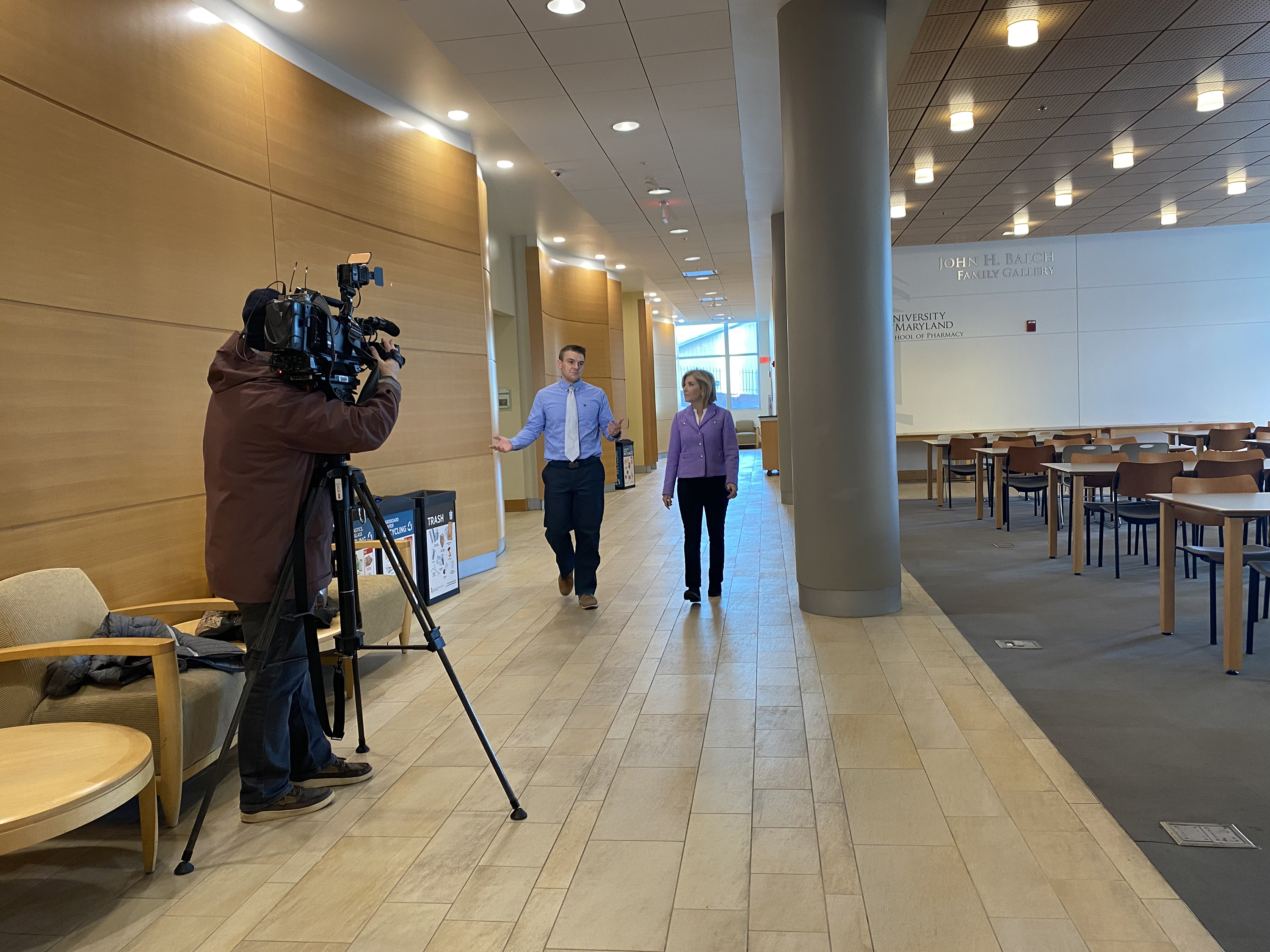
its Knowledge Enterprise are "game changers," says Mona Tsoukleris, PharmD (pictured above), an
associate professor in PPS. "We have a perfect storm for community pharmacy. We need to seize that
energy. Pharmacists are the most accessible health care providers for
patients and now we have the government's backing through funding from
DHMH for this program," says Tsoukleris.
The concept of CIPS was launched by the School of Pharmacy about four
years ago, as a response to health care needs in the state and
nationally. In June 2011, the School held a National Leadership
Roundtable of leaders from pharmacy, medicine, health insurers, and
state and federal government agencies. The assembled consortium
recommended training, research, and advocacy models to guide
pharmacists nationwide in assuming expanded needs outlined in health
care reform efforts. "The pharmacist is in a unique position," says
Tsoukleris, and the CIPS Knowledge Enterprise's asthma training course is "the first of many such modules available to assist pharmacists
nationwide to assume expanded health care reform needs," she says.
Rodriguez de Bittner says "the story of CIPS is how we are responding
to the pharmacy profession's needs when it comes to health care reform.
The national roundtable in 2011 helped confirm the role that CIPS has
locally and nationally in training and developing new care models to
deliver medication management services. We have been able to
demonstrate how pharmacist's services improve care and reduce overall
health care costs."
So far, the School has raised $1.1 million in grants for CIPS training,
research for new models of care, and advocacy, says Rodriguez de
Bittner. "There are other training programs, but what is unique about
us is that any model we test, we have an accompanying business model,"
she says. "It is not just developing a program and testing it to assess
the patient care piece, but we are also looking for financially
sustainable models within this new structure of health care reform. We
are testing models in a variety of settings, including our Patient
Centered Medical Home Program, and the Maryland P3 [Patients,
Pharmacists, Partnerships] Program."
The Maryland General Assembly passed legislation in 2010 establishing
the Maryland Multipayer Patient Centered Medical Home Program, which is
evaluating whether the patient-centered medical home program, using
multiple data sources such as claims, interviews, and medical records,
improves health care quality, health outcomes, while reducing the cost
of care. And the Maryland P3 Program provides employers with specially
trained pharmacist coaches for step-by-step guidance in medication
adherence, lifestyle changes, and self-care skills. Employers who have
signed up are saving about $1,000 per employee per year in health care
expenses.
Immediately following the initial CIPS asthma class, Tsoukleris
summarized, "We have people still dying of asthma and almost every
death is preventable. You shouldn't have to die from asthma. We as
pharmacists need to spend the time even in small increments to improve
the situation."
|
| Posting Date: 11/07/2012 |
| Contact Name: Steve Berberich |
| Contact Phone: 410-706-0023 |
| Contact Email: sberb001@umaryland.edu |
|